

Minimum Number of Visited Cells in a Grid
Hard
You are given a 0-indexed m x n integer matrix grid. Your initial position is at the top-left cell (0, 0).
Starting from the cell (i, j), you can move to one of the following cells:
- Cells
(i, k)withj < k <= grid[i][j] + j(rightward movement), or - Cells
(k, j)withi < k <= grid[i][j] + i(downward movement).
Return the minimum number of cells you need to visit to reach the bottom-right cell (m - 1, n - 1). If there is no valid path, return -1.
Example 1:
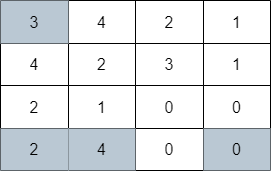
Input: grid = [[3,4,2,1],[4,2,3,1],[2,1,0,0],[2,4,0,0]]
Output: 4
Explanation: The image above shows one of the paths that visits exactly 4 cells.
Example 2:

Input: grid = [[3,4,2,1],[4,2,1,1],[2,1,1,0],[3,4,1,0]]
Output: 3
Explanation: The image above shows one of the paths that visits exactly 3 cells.
Example 3:

Input: grid = [[2,1,0],[1,0,0]]
Output: -1
Explanation: It can be proven that no path exists.
Constraints:
m == grid.lengthn == grid[i].length1 <= m, n <= 1051 <= m * n <= 1050 <= grid[i][j] < m * ngrid[m - 1][n - 1] == 0

Solution
Clarifying Questions
When you get asked this question in a real-life environment, it will often be ambiguous (especially at FAANG). Make sure to ask these questions in that case:
- What are the constraints on the dimensions of the grid (m and n), and the range of values within the grid cells?
- Is it possible for a cell value `grid[i][j]` to be zero, and if so, what does that imply for movement from that cell?
- If it's impossible to reach the bottom-right cell from the top-left cell, what should I return?
- Can I assume that the grid will always be rectangular (i.e., all rows have the same number of columns)?
- Are there any memory constraints I should be aware of, given the potential grid size?
Brute Force Solution
Approach
We want to find the shortest path through a grid, where each cell tells us how far we can jump. The brute force approach explores every possible path we could take through the grid, one step at a time, until we find the destination.
Here's how the algorithm would work step-by-step:
- Start at the beginning cell of the grid.
- From that cell, consider every possible jump distance allowed by the number in that cell.
- For each jump, mark that new cell as visited and add it to the current path.
- Continue jumping from each new cell, again considering all possible jump distances and adding each new cell to the path.
- If a path leads us to the end cell, record the number of cells we visited in that path.
- If a path leads to a dead end (we can't jump anywhere new), backtrack to the previous cell and try a different jump.
- Repeat this process, trying every possible path through the grid.
- Once we've explored all possible paths, compare the number of cells visited for all paths that reached the end.
- The path with the fewest visited cells is the answer.
Code Implementation
def minimum_visited_cells_brute_force(grid):
    rows = len(grid)
    cols = len(grid[0])

    if rows == 0 or cols == 0:
        return -1

    min_cells = float('inf')

    def explore_path(current_row, current_col, visited_cells):
        nonlocal min_cells

        # If we reach the destination, update the minimum cells visited
        if current_row == rows - 1 and current_col == cols - 1:
            min_cells = min(min_cells, len(visited_cells))
            return

        jump_distance = grid[current_row][current_col]

        # Explore all possible horizontal jumps
        for next_col in range(current_col + 1, min(current_col + jump_distance + 1, cols)):
            if (current_row, next_col) not in visited_cells:
                explore_path(current_row, next_col, visited_cells | {(current_row, next_col)})

        # Explore all possible vertical jumps
        for next_row in range(current_row + 1, min(current_row + jump_distance + 1, rows)):
            if (next_row, current_col) not in visited_cells:
                explore_path(next_row, current_col, visited_cells | {(next_row, current_col)})

    explore_path(0, 0, {(0, 0)})

    if min_cells == float('inf'):
        return -1
    else:
return min_cellsBig(O) Analysis
Optimal Solution
Approach
The key to efficiently finding the minimum path through the grid is to avoid re-exploring areas we've already determined a best path for. We achieve this by focusing on expanding outwards in the grid using the maximum jump possible from each cell, recording the best paths as we go.
Here's how the algorithm would work step-by-step:
- Start at the beginning cell.
- From your current location, determine how far you can jump based on the cell's value.
- Imagine exploring every cell within your jump range, both horizontally and vertically.
- Instead of immediately moving, figure out which reachable cell has not been explored yet or is reachable from a shorter path.
- Move to this cell and record your current path length (number of steps taken).
- Repeat this process of jumping, evaluating reachable cells, and moving to the best new cell until you reach the end cell.
- By strategically jumping the maximum range and only focusing on unexplored cells and shorter paths, you avoid redundant calculations and find the shortest path more efficiently.
Code Implementation
def minimum_visited_cells(grid):
    rows = len(grid)
    cols = len(grid[0])

    if rows == 1 and cols == 1:
        return 1

    visited_cells = [[-1] * cols for _ in range(rows)]
    visited_cells[0][0] = 1
    queue = [(0, 0)]

    while queue:
        row_index, column_index = queue.pop(0)
        jump_range = grid[row_index][column_index]

        # Check horizontal reachable cells
        for next_column_index in range(column_index + 1, min(column_index + jump_range + 1, cols)):
            if visited_cells[row_index][next_column_index] == -1:
                visited_cells[row_index][next_column_index] = visited_cells[row_index][column_index] + 1
                # Add to queue because we found an unvisited cell
                queue.append((row_index, next_column_index))

        # Check vertical reachable cells
        for next_row_index in range(row_index + 1, min(row_index + jump_range + 1, rows)):
            if visited_cells[next_row_index][column_index] == -1:
                visited_cells[next_row_index][column_index] = visited_cells[row_index][column_index] + 1
                # Add to queue because we found an unvisited cell
                queue.append((next_row_index, column_index))

    return visited_cells[rows - 1][cols - 1]
Big(O) Analysis
Edge Cases
| Case | How to Handle |
|---|---|
| Null or empty grid | Return -1 if the grid is null or has zero rows/columns because a path is impossible. |
| 1x1 grid | Return 1 immediately because only the starting cell needs to be visited. |
| Path does not exist (unreachable bottom-right) | If BFS/DFS explores all possible cells without finding the target, return -1 to indicate no path. |
| Large grid dimensions (potential for stack overflow with naive recursion) | Use an iterative approach (BFS or Dijkstra's with priority queue) to avoid stack overflow for large grids. |
| grid[i][j] value of 0 | Handle zero values correctly in the path traversal, preventing movement and potentially leading to unreachable states which are handled by returning -1 if a path can't be found. |
| Integer overflow when calculating distances or indices | Ensure that all calculations involving grid indices or number of steps do not exceed the maximum integer value by using appropriate data types (e.g., long). |
| Grid with large grid[i][j] values (potential for out-of-bounds access) | Carefully check that next cell indices after moving down or right are within the bounds of the grid to avoid array index out-of-bounds exceptions. |
| Grid with all values being large, allowing potentially multiple optimal paths | The BFS/Dijkstra's algorithm will find the shortest path(s) even if multiple paths with the minimum number of visited cells exist. |






