

Minimum Operations to Make a Uni-Value Grid
Medium


You are given a 2D integer grid of size m x n and an integer x. In one operation, you can add x to or subtract x from any element in the grid.
A uni-value grid is a grid where all the elements of it are equal.
Return the minimum number of operations to make the grid uni-value. If it is not possible, return -1.
Example 1:
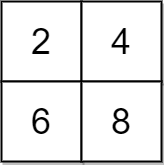
Input: grid = [[2,4],[6,8]], x = 2
Output: 4
Explanation: We can make every element equal to 4 by doing the following:
- Add x to 2 once.
- Subtract x from 6 once.
- Subtract x from 8 twice.
A total of 4 operations were used.
Example 2:

Input: grid = [[1,5],[2,3]], x = 1
Output: 5
Explanation: We can make every element equal to 3.
Example 3:

Input: grid = [[1,2],[3,4]], x = 2
Output: -1
Explanation: It is impossible to make every element equal.
Constraints:
m == grid.lengthn == grid[i].length1 <= m, n <= 1051 <= m * n <= 1051 <= x, grid[i][j] <= 104

Solution
Clarifying Questions
When you get asked this question in a real-life environment, it will often be ambiguous (especially at FAANG). Make sure to ask these questions in that case:
- What are the constraints on the dimensions of the grid and the values within the grid, as well as on the value of 'x'?
- Can the input grid be empty or null? What should be returned in those cases?
- If it is impossible to make all elements equal using the given operation, should I return -1, or is there another specified error value?
- Is 'x' guaranteed to be a positive integer? What should I do if 'x' is zero?
- If multiple values exist that the grid elements could be transformed to with minimal operations, is there a specific value I should aim for?
Brute Force Solution
Approach
The brute force strategy involves trying every possible target value for the grid. For each potential target, we calculate the operations needed to transform all cells to that target and keep track of the minimum operations found so far.
Here's how the algorithm would work step-by-step:
- First, identify the smallest and largest numbers present in the grid.
- Then, consider every number between the smallest and largest as a potential target value.
- For each potential target value, go through each cell in the grid.
- Calculate how many operations it would take to change the value in the cell to equal the target value.
- Add up all these operations for all cells in the grid to get a total operation count for that target.
- If the difference between any cell value and our target is not divisible by a given number, we can stop calculating because that target is invalid.
- Keep track of the lowest total operation count found so far across all the valid target values.
- After checking all possible target values, report the lowest total operation count found.
Code Implementation
def min_operations_uni_value_grid_brute_force(grid, difference):
    smallest_number = float('inf')
    largest_number = float('-inf')

    for row in grid:
        smallest_number = min(smallest_number, min(row))
        largest_number = max(largest_number, max(row))

    minimum_operations = float('inf')

    # Consider every number between smallest and largest as potential target
    for target_value in range(smallest_number, largest_number + 1):
        total_operations = 0
        is_valid = True

        for row in grid:
            for cell_value in row:

                # If the difference is not divisible, the target is invalid
                if abs(cell_value - target_value) % difference != 0:
                    is_valid = False
                    break

                total_operations += abs(cell_value - target_value) // difference
            if not is_valid:
                break

        # Only update min ops if the target was valid.
        if is_valid:
            minimum_operations = min(minimum_operations, total_operations)

    if minimum_operations == float('inf'):
        return -1
    else:
return minimum_operationsBig(O) Analysis
Optimal Solution
Approach
The challenge is to find the fewest changes needed to make all numbers in a grid the same. The most efficient way involves finding the middle number and changing all other numbers to match it. This leverages the properties of medians to minimize overall change.
Here's how the algorithm would work step-by-step:
- First, check if the difference between any two numbers in the grid isn't divisible by the given difference allowed between numbers; if it's not, you can't make the grid uni-value, so stop.
- If all differences are divisible, put all the numbers from the grid into a single, sorted list.
- Find the number that's exactly in the middle of this sorted list. This is called the median.
- For every number in the original grid, calculate the number of steps needed to change it to the median. You can find this by figuring out the difference between the original number and the median, then dividing by the difference allowed.
- Add up all the steps calculated in the previous step. This total is the minimum number of operations needed to make the grid uni-value.
Code Implementation
def min_operations_to_make_uni_value_grid(grid, difference_allowed):
    number_of_rows = len(grid)
    number_of_columns = len(grid[0])
    all_numbers = []

    for row_index in range(number_of_rows):
        for column_index in range(number_of_columns):
            all_numbers.append(grid[row_index][column_index])

    # Check divisibility before proceeding
    for first_index in range(len(all_numbers)):
        for second_index in range(first_index + 1, len(all_numbers)):
            if abs(all_numbers[first_index] - all_numbers[second_index]) % difference_allowed != 0:
                return -1

    all_numbers.sort()
    median_index = len(all_numbers) // 2
    median_value = all_numbers[median_index]

    total_operations = 0

    # Accumulate operations needed for each element.
    for row_index in range(number_of_rows):
        for column_index in range(number_of_columns):
            total_operations += abs(grid[row_index][column_index] - median_value) // difference_allowed

return total_operationsBig(O) Analysis
Edge Cases
| Case | How to Handle |
|---|---|
| Null or empty grid | Return -1 immediately as there are no elements to make equal. |
| Grid with only one element | Return 0 since all elements are already equal. |
| x is zero | Return 0 if all elements are equal; otherwise return -1 because no operation will change the values if x is 0 and grid elements are not equal. |
| Grid elements are not divisible by x to reach a common value | Return -1 if the difference between any two grid elements is not divisible by x. |
| Grid elements are very large numbers (potential overflow) | Use long data type to store grid elements and intermediate calculations to prevent integer overflow. |
| Large grid size (scalability) | Using the median minimizes total distance, so an O(m*n*log(m*n)) sorting approach is suitable for larger grids. |
| Grid contains negative numbers | The solution should work correctly with negative numbers as the absolute difference is still relevant. |
| All elements in the grid are already equal | Return 0, as no operations are needed. |






