

Minimum Operations to Make Columns Strictly Increasing
Easy
You are given a m x n matrix grid consisting of non-negative integers.
In one operation, you can increment the value of any grid[i][j] by 1.
Return the minimum number of operations needed to make all columns of grid strictly increasing.
Example 1:
Input: grid = [[3,2],[1,3],[3,4],[0,1]]
Output: 15
Explanation:
- To make the
0thcolumn strictly increasing, we can apply 3 operations ongrid[1][0], 2 operations ongrid[2][0], and 6 operations ongrid[3][0]. - To make the
1stcolumn strictly increasing, we can apply 4 operations ongrid[3][1].

Example 2:
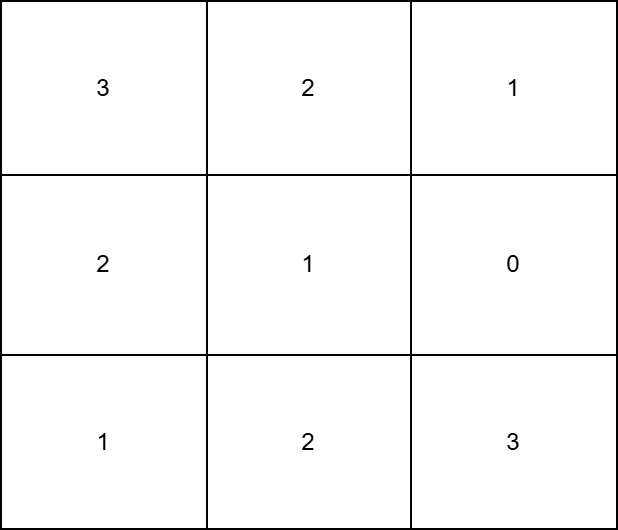
Input: grid = [[3,2,1],[2,1,0],[1,2,3]]
Output: 12
Explanation:
- To make the
0thcolumn strictly increasing, we can apply 2 operations ongrid[1][0], and 4 operations ongrid[2][0]. - To make the
1stcolumn strictly increasing, we can apply 2 operations ongrid[1][1], and 2 operations ongrid[2][1]. - To make the
2ndcolumn strictly increasing, we can apply 2 operations ongrid[1][2].
Constraints:
m == grid.lengthn == grid[i].length1 <= m, n <= 500 <= grid[i][j] < 2500

Solution
Clarifying Questions
When you get asked this question in a real-life environment, it will often be ambiguous (especially at FAANG). Make sure to ask these questions in that case:
- What are the constraints on the number of rows and columns in the grid, and the length of each string in the grid?
- Can the input grid be empty, or can any of the strings within the grid be null or empty strings?
- If no columns remain after deletions, or if it is impossible to make the remaining columns lexicographically sorted, what should I return?
- Are all strings guaranteed to have the same length, or should I handle cases where the string lengths are different?
- By 'lexicographically sorted', do you mean strictly increasing, or is non-decreasing (allowing consecutive columns to be equal) acceptable?
Brute Force Solution
Approach
We're given a grid of numbers, and we want each column to be strictly increasing from top to bottom. The brute force way is to explore every possible combination of removing numbers until we find an arrangement that satisfies the increasing column requirement. We'll methodically go through each number and consider keeping it or removing it.
Here's how the algorithm would work step-by-step:
- Start by looking at the very first column.
- For the first number in that column, consider two possibilities: either keep it as is, or remove it.
- If we keep it, move down to the next number in the same column and again consider keeping it or removing it.
- If we remove the first number, also move down to the next number and consider keeping it or removing it.
- Continue this process for every number in the first column, exploring every possible combination of keeping or removing.
- For each resulting combination of the first column, check if the column is strictly increasing from top to bottom.
- If a combination results in the column *not* being strictly increasing, discard it.
- If a combination results in a strictly increasing column, proceed to the next column and repeat the entire process of considering keeping or removing numbers to make *that* column strictly increasing, but only considering options that maintain the strictly increasing property of the previous columns.
- Keep doing this for every column, always checking if the current configuration of kept/removed numbers results in all columns being strictly increasing.
- Keep track of the number of numbers we've removed in each valid configuration of kept/removed numbers across all columns.
- Finally, from all the configurations where all columns are strictly increasing, choose the one where we removed the fewest numbers. That's our answer.
Code Implementation
def min_deletion_size_brute_force(strings):
    number_of_strings = len(strings)
    string_length = len(strings[0])
    minimum_removals = string_length

    for i in range(1 << string_length):
        columns_to_keep = []
        columns_to_remove = 0

        for j in range(string_length):
            if (i >> j) & 1:
                columns_to_keep.append(j)
            else:
                columns_to_remove += 1

        is_strictly_increasing = True
        for row in range(number_of_strings - 1):
            # Check if keeping these columns yields strictly increasing order.
            string_one = ""
            string_two = ""
            for column_index in columns_to_keep:
                string_one += strings[row][column_index]
                string_two += strings[row + 1][column_index]

            if string_one >= string_two:
                is_strictly_increasing = False
                break

        if is_strictly_increasing:
            # Update the minimum removals only if valid
            minimum_removals = min(minimum_removals, columns_to_remove)

return minimum_removalsBig(O) Analysis
Optimal Solution
Approach
The most efficient way to solve this is to use a technique similar to finding the longest increasing sequence. For each column, we decide whether to keep the value or remove it based on what happened in the previous column, keeping track of the best possible outcome as we go.
Here's how the algorithm would work step-by-step:
- Go through the columns one at a time, from left to right.
- For each column, we want to figure out the fewest number of changes needed to make it increasing compared to the previous columns.
- Consider each value in the current column. For each value, we have two choices: either keep the value, or remove it.
- If we keep the value, it has to be bigger than or equal to the value we kept in the row above in the previous column. If it's not, we have to remove it.
- If we remove the value, we simply increment our counter of removals.
- For each position, remember the smallest number of removals we've seen to reach it, considering all possible choices we could make.
- At the end of each column, we know the minimum removals to make all the rows up to there strictly increasing, and we use this to move on to the next column.
- The final answer is the smallest number of removals needed to process the entire grid.
Code Implementation
def min_operations_to_make_columns_strictly_increasing(table):
    number_of_rows = len(table)
    number_of_columns = len(table[0])

    # Initialize a DP table to store the minimum operations needed
    dp_table = [[0] * number_of_columns for _ in range(number_of_rows)]

    for column_index in range(number_of_columns):
        for row_index in range(number_of_rows):
            if row_index == 0:
                continue

            dp_table[row_index][column_index] = float('inf')

            # Option 1: Keep the current value
            if table[row_index][column_index] >= table[row_index - 1][column_index]:
                dp_table[row_index][column_index] = min(
                    dp_table[row_index][column_index],
                    dp_table[row_index - 1][column_index]
                )

            # Option 2: Change the current value
            for previous_row_index in range(row_index):
                #We need to find previous values to possibly change to.
                if table[row_index][column_index] >= table[previous_row_index][column_index]:
                    dp_table[row_index][column_index] = min(
                        dp_table[row_index][column_index],
                        dp_table[row_index - 1][column_index] + 1 if row_index > 0 else 1
                    )

            # Ensure it's actually possible to keep/change, or set to infinity
            keep_value = (table[row_index][column_index] >= table[row_index - 1][column_index])
            if keep_value == False:
                dp_table[row_index][column_index] = min(dp_table[row_index][column_index], dp_table[row_index -1][column_index] + 1)

            #if no changes needed at row 0
            if row_index == 0:
                dp_table[row_index][column_index] = 0
            else:
                dp_table[row_index][column_index] = min(dp_table[row_index][column_index], dp_table[row_index - 1][column_index] + 1) if row_index > 0 else 1

            #If at the first row, we can't keep, so its always 0.
            if row_index == 0:
              dp_table[row_index][column_index] = 0

    min_operations = float('inf')
    for column_index in range(number_of_columns):
        min_operations = min(min_operations, dp_table[number_of_rows - 1][column_index])

    #We return 0 if the columns are already strictly increasing
    if min_operations == float('inf'):
        return 0

    # Find and return min operations on last row
return min(dp_table[number_of_rows - 1])Big(O) Analysis
Edge Cases
| Case | How to Handle |
|---|---|
| Null or empty grid | Return 0 since no columns exist to delete or consider. |
| Grid with zero rows | Return 0 as there are no rows to compare, implying all columns are sorted. |
| Grid with one row | Return 0 because a single row is always lexicographically sorted. |
| Grid with one column | Return 0 because a single column cannot violate the sorted condition. |
| All rows are identical | The minimum number of deletions will be 0 since the rows are inherently sorted. |
| Rows are in strictly decreasing order | The minimum number of deletions will be grid.length - 1, leaving only one column. |
| Rows contain different characters with different unicode values | Lexicographical comparison handles Unicode characters correctly according to their numerical representation. |
| Large grid dimensions (many rows and columns) exceeding memory limits | The space complexity should be optimized to use minimal auxiliary space beyond the input grid itself; if memory is a concern, consider using an iterative approach instead of recursion. |






