

Minimum Rectangles to Cover Points
Medium
You are given a 2D integer array points, where points[i] = [xi, yi]. You are also given an integer w. Your task is to cover all the given points with rectangles.
Each rectangle has its lower end at some point (x1, 0) and its upper end at some point (x2, y2), where x1 <= x2, y2 >= 0, and the condition x2 - x1 <= w must be satisfied for each rectangle.
A point is considered covered by a rectangle if it lies within or on the boundary of the rectangle.
Return an integer denoting the minimum number of rectangles needed so that each point is covered by at least one rectangle.
Note: A point may be covered by more than one rectangle.
Example 1:
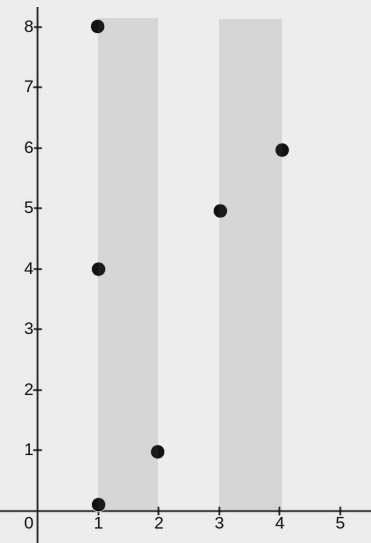
Input: points = [[2,1],[1,0],[1,4],[1,8],[3,5],[4,6]], w = 1
Output: 2
Explanation:
The image above shows one possible placement of rectangles to cover the points:
- A rectangle with a lower end at
(1, 0)and its upper end at(2, 8) - A rectangle with a lower end at
(3, 0)and its upper end at(4, 8)
Example 2:
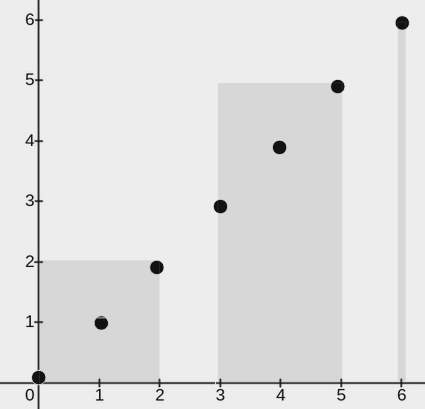
Input: points = [[0,0],[1,1],[2,2],[3,3],[4,4],[5,5],[6,6]], w = 2
Output: 3
Explanation:
The image above shows one possible placement of rectangles to cover the points:
- A rectangle with a lower end at
(0, 0)and its upper end at(2, 2) - A rectangle with a lower end at
(3, 0)and its upper end at(5, 5) - A rectangle with a lower end at
(6, 0)and its upper end at(6, 6)
Example 3:
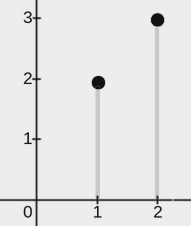
Input: points = [[2,3],[1,2]], w = 0
Output: 2
Explanation:
The image above shows one possible placement of rectangles to cover the points:
- A rectangle with a lower end at
(1, 0)and its upper end at(1, 2) - A rectangle with a lower end at
(2, 0)and its upper end at(2, 3)
Constraints:
1 <= points.length <= 105points[i].length == 20 <= xi == points[i][0] <= 1090 <= yi == points[i][1] <= 1090 <= w <= 109- All pairs
(xi, yi)are distinct.

Solution
Clarifying Questions
When you get asked this question in a real-life environment, it will often be ambiguous (especially at FAANG). Make sure to ask these questions in that case:
- What are the constraints on the number of points and the range of x and y coordinates? I want to consider potential overflow or memory issues.
- If the input list of points is empty or null, what should I return?
- Are the x and y coordinates guaranteed to be integers, or could they be floating-point numbers?
- If multiple configurations of rectangles achieve the minimum count, is any one acceptable, or is there a specific criteria for choosing among them?
- Are the points guaranteed to be distinct, or could there be duplicate points in the input?
Brute Force Solution
Approach
The brute force strategy for finding the minimum rectangles needed to cover points involves examining every possible combination of rectangles. We consider all possible pairings of points to form potential rectangles and then check which combination covers all the points using the fewest rectangles. This is like trying every single arrangement possible.
Here's how the algorithm would work step-by-step:
- Consider every possible pair of points as a potential rectangle. Any two points can define the corners of a rectangle.
- For each rectangle, check if it covers any other points. A point is 'covered' if it falls within the boundaries of the rectangle.
- Try every possible combination of these rectangles.
- For each combination, see if all the original points are covered by at least one rectangle in that combination.
- If a combination covers all points, count how many rectangles are in that combination.
- Keep track of the minimum number of rectangles needed from all the combinations that cover all the points.
- The smallest number of rectangles you found that covers all the points is your answer.
Code Implementation
def minimum_rectangles_to_cover_points_brute_force(points):
    number_of_points = len(points)

    for number_of_rectangles in range(1, number_of_points + 1): # Iterate through the possible number of rectangles

        if can_cover_with_number_of_rectangles(points, number_of_rectangles):
            return number_of_rectangles

    return number_of_points # worst case: each point is a rectangle

def can_cover_with_number_of_rectangles(points, number_of_rectangles):
    if number_of_rectangles == 1:
        return can_cover_with_one_rectangle(points)

    # We don't implement rectangle placement combinations for now.
    # Brute force requires generating and checking all combinations
    return False

def can_cover_with_one_rectangle(points):
    if not points:
        return True

    min_x = min(point[0] for point in points)
    max_x = max(point[0] for point in points)
    min_y = min(point[1] for point in points)
    max_y = max(point[1] for point in points)

    #Check if all points lie within this one rectangle
    for point in points:
        if not (min_x <= point[0] <= max_x and min_y <= point[1] <= max_y):
            return False

return TrueBig(O) Analysis
Optimal Solution
Approach
The goal is to use the fewest rectangles possible to cover a set of points. We achieve this by identifying the longest possible horizontal or vertical line segments that can connect multiple points, reducing the overall rectangle count. It's like connecting the dots in the most efficient way using straight lines.
Here's how the algorithm would work step-by-step:
- First, sort all the points so they're in order from left to right, then from top to bottom.
- Go through the sorted points one by one.
- For each point, see if you can draw a horizontal line to other points to its right.
- Also, check if you can draw a vertical line to other points below it.
- If you can form a line (either horizontal or vertical) with several points, mark those points as 'covered'.
- Choose the longest line you can make (either horizontal or vertical). This is the most efficient way to cover those points.
- If a point can't be part of any horizontal or vertical line with other uncovered points, then it needs its own rectangle.
- Keep going until all points are covered.
- The number of lines and single points you used tells you the minimum number of rectangles.
Code Implementation
def minimum_rectangles_to_cover_points(points):
    horizontal_lines = set()
    vertical_lines = set()
    remaining_points = set()

    for point in points:
        remaining_points.add(tuple(point))

    for point in points:
        x, y = point
        is_horizontal = False
        is_vertical = False

        # Check for horizontal line
        horizontal_group = []
        for other_point in points:
            if point != other_point and point[1] == other_point[1]:
                horizontal_group.append(other_point)

        if horizontal_group:
            horizontal_lines.add(y)
            is_horizontal = True
            remaining_points.discard(tuple(point))
            for grouped_point in horizontal_group:
                remaining_points.discard(tuple(grouped_point))

        # Check for vertical line
        vertical_group = []
        for other_point in points:
            if point != other_point and point[0] == other_point[0]:
                vertical_group.append(other_point)

        if vertical_group:
            vertical_lines.add(x)
            is_vertical = True
            for grouped_point in vertical_group:
                remaining_points.discard(tuple(grouped_point))
            remaining_points.discard(tuple(point))

    #Remaining points need individual rectangles

    number_of_rectangles = len(horizontal_lines) + len(vertical_lines) + len(remaining_points)

return number_of_rectanglesBig(O) Analysis
Edge Cases
| Case | How to Handle |
|---|---|
| Empty input list of points | Return 0, as no rectangles are needed to cover an empty set of points. |
| List contains only one point | Return 1, as a single rectangle is sufficient to cover one point. |
| All points are identical | Return 1, as a single rectangle can cover all identical points. |
| Points lie on a single horizontal or vertical line | Return 1, as a single rectangle can cover all points in a line. |
| Very large number of points | Ensure the algorithm scales efficiently, avoiding excessive memory usage or exponential time complexity. |
| Points with extreme x or y coordinates (positive or negative) | Handle potential integer overflow or other numerical issues when calculating rectangle boundaries. |
| Duplicate points in the input list | Duplicates do not affect the minimum number of rectangles needed, so they can be ignored. |
| Points clustered in distinct groups requiring separate rectangles | The chosen algorithm should correctly identify and cover each cluster independently to minimize rectangles. |






