

Minimum Time to Visit Disappearing Nodes
Medium
There is an undirected graph of n nodes. You are given a 2D array edges, where edges[i] = [ui, vi, lengthi] describes an edge between node ui and node vi with a traversal time of lengthi units.
Additionally, you are given an array disappear, where disappear[i] denotes the time when the node i disappears from the graph and you won't be able to visit it.
Note that the graph might be disconnected and might contain multiple edges.
Return the array answer, with answer[i] denoting the minimum units of time required to reach node i from node 0. If node i is unreachable from node 0 then answer[i] is -1.
Example 1:
Input: n = 3, edges = [[0,1,2],[1,2,1],[0,2,4]], disappear = [1,1,5]
Output: [0,-1,4]
Explanation:

We are starting our journey from node 0, and our goal is to find the minimum time required to reach each node before it disappears.
- For node 0, we don't need any time as it is our starting point.
- For node 1, we need at least 2 units of time to traverse
edges[0]. Unfortunately, it disappears at that moment, so we won't be able to visit it. - For node 2, we need at least 4 units of time to traverse
edges[2].
Example 2:
Input: n = 3, edges = [[0,1,2],[1,2,1],[0,2,4]], disappear = [1,3,5]
Output: [0,2,3]
Explanation:
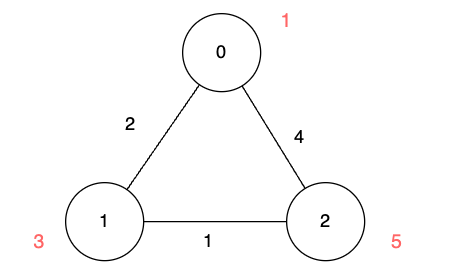
We are starting our journey from node 0, and our goal is to find the minimum time required to reach each node before it disappears.
- For node 0, we don't need any time as it is the starting point.
- For node 1, we need at least 2 units of time to traverse
edges[0]. - For node 2, we need at least 3 units of time to traverse
edges[0]andedges[1].
Example 3:
Input: n = 2, edges = [[0,1,1]], disappear = [1,1]
Output: [0,-1]
Explanation:
Exactly when we reach node 1, it disappears.
Constraints:
1 <= n <= 5 * 1040 <= edges.length <= 105edges[i] == [ui, vi, lengthi]0 <= ui, vi <= n - 11 <= lengthi <= 105disappear.length == n1 <= disappear[i] <= 105

Solution
Clarifying Questions
When you get asked this question in a real-life environment, it will often be ambiguous (especially at FAANG). Make sure to ask these questions in that case:
- What is the data type and range for the node values and the time taken to traverse an edge?
- Can the graph be disconnected? If so, how should I handle nodes that are unreachable before they disappear?
- If a node disappears at the exact moment I arrive, can I still 'visit' it, or is it considered gone?
- Is the graph represented as an adjacency list, adjacency matrix, or something else? Can I assume it's directed or undirected?
- If multiple paths result in the same minimum time, is any of them acceptable, or is there a tie-breaking criteria (e.g., visiting the nodes in ascending order of value)?
Brute Force Solution
Approach
Imagine you're planning a road trip visiting several disappearing attractions. The brute force approach means trying every single possible route you could take to visit all the attractions. We want to find the route that takes the least amount of total travel time.
Here's how the algorithm would work step-by-step:
- Start by considering every possible order you could visit the attractions.
- For each possible order, calculate the total travel time by adding up the time it takes to go from one attraction to the next in that specific order.
- If an attraction disappears before you can visit it in a given order, that order is not a valid option.
- Keep track of the total travel time for each valid order.
- Compare the total travel times of all the valid orders.
- The order with the shortest total travel time is the best route.
Code Implementation
from itertools import permutations

def minimum_time_to_visit_nodes_brute_force(times, disappear_times):
    number_of_nodes = len(times)
    min_time = float('inf')

    # Generate all possible orderings of node visits
    for node_order in permutations(range(number_of_nodes)):
        current_time = 0
        is_valid_order = True

        # Iterate through the order to calculate the total time
        for i in range(number_of_nodes - 1):
            current_node = node_order[i]
            next_node = node_order[i + 1]
            travel_time = times[current_node][next_node]
            current_time += travel_time

            # Check if the node disappears before it is visited
            if current_time > disappear_times[next_node]:
                is_valid_order = False
                break

        # We want to consider only valid orderings
        if is_valid_order:
            first_node = node_order[0]
            if current_time <= disappear_times[first_node]:

                # Update minimum time if this route is shorter
                min_time = min(min_time, current_time)
            else:
                continue

    # Return the minimum time if a valid path exists
    if min_time == float('inf'):
        return -1
    else:
return min_timeBig(O) Analysis
Optimal Solution
Approach
The problem involves navigating a graph where nodes disappear over time, and we want to minimize the total travel time. The optimal approach uses a strategy similar to Dijkstra's algorithm but accounts for the nodes disappearing by only considering paths where nodes exist when we arrive at them.
Here's how the algorithm would work step-by-step:
- First, determine the time each node disappears. This is given as part of the problem.
- Next, keep track of the shortest time to reach each node from the starting node. Initialize the starting node's time to zero and all other nodes' times to infinity (or a very large number).
- Use a priority queue to visit nodes in order of the shortest known time to reach them. The priority queue helps us process the most promising nodes first.
- When you visit a node, consider all of its neighbors. For each neighbor, check if the current time plus the travel time to that neighbor is less than the neighbor's current shortest time, and also check if the neighbor will still exist (not disappeared) at the time we would arrive.
- If both conditions are met, update the neighbor's shortest time and add it to the priority queue. This is similar to how Dijkstra's algorithm updates distances.
- Continue this process until you've visited all reachable nodes or the priority queue is empty. The shortest time to reach the destination node will then be the answer.
Code Implementation
import heapq

def min_time_to_visit_nodes(graph, disappear_times, start_node, end_node):
    number_of_nodes = len(disappear_times)
    shortest_time = [float('inf')] * number_of_nodes
    shortest_time[start_node] = 0

    priority_queue = [(0, start_node)]

    while priority_queue:
        current_time, current_node = heapq.heappop(priority_queue)

        if current_time > shortest_time[current_node]:
            continue

        # Iterate through each of the neighbors.
        for neighbor, travel_time in graph[current_node]:
            arrival_time = current_time + travel_time

            # Important to check if node exists at arrival time.
            if arrival_time < shortest_time[neighbor] and \
               arrival_time <= disappear_times[neighbor]:

                shortest_time[neighbor] = arrival_time
                heapq.heappush(priority_queue, (arrival_time, neighbor))

    # If unreachable return -1.
    if shortest_time[end_node] == float('inf'):
        return -1
    else:
return shortest_time[end_node]Big(O) Analysis
Edge Cases
| Case | How to Handle |
|---|---|
| Null or empty list of nodes | Return 0 immediately as there are no nodes to visit. |
| List of nodes contains only one node | Return 0 immediately as there are no other nodes to visit. |
| All nodes disappear at time 0 | Return infinity, or -1 if infinity is not allowed, as all nodes disappear before we can reach them. |
| The graph has no edges | If the starting node disappears at time 0, return infinity, otherwise the optimal time is zero. |
| The graph contains cycles, but nodes still disappear | The algorithm should be able to handle cycles by maintaining a visited set during graph traversal or using Dijkstra's/BFS with careful state management accounting for time. |
| Integer overflow when calculating time, especially with large graphs or large disappearance times | Use long integers to store the time to avoid overflow issues. |
| Maximum number of nodes allowed by the problem is reached, causing performance degradation | Ensure the chosen algorithm (e.g., BFS, Dijkstra's) scales well with the maximum number of nodes and edges. |
| Disappearance times are negative | Treat negative disappearance times as instantaneous disappearance at time 0, or throw an error indicating invalid input. |






