

Minimum Time Visiting All Points
Easy

On a 2D plane, there are n points with integer coordinates points[i] = [xi, yi]. Return the minimum time in seconds to visit all the points in the order given by points.
You can move according to these rules:
- In
1second, you can either:- move vertically by one unit,
- move horizontally by one unit, or
- move diagonally
sqrt(2)units (in other words, move one unit vertically then one unit horizontally in1second).
- You have to visit the points in the same order as they appear in the array.
- You are allowed to pass through points that appear later in the order, but these do not count as visits.
Example 1:
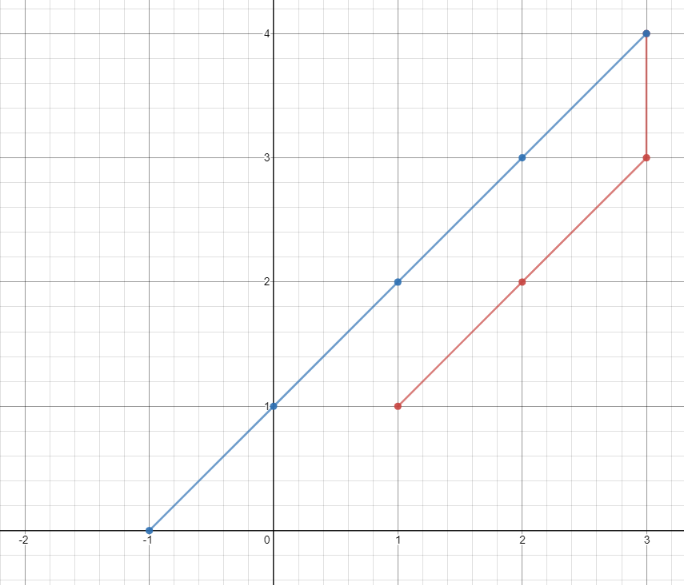
Input: points = [[1,1],[3,4],[-1,0]]
Output: 7
Explanation: One optimal path is [1,1] -> [2,2] -> [3,3] -> [3,4] -> [2,3] -> [1,2] -> [0,1] -> [-1,0]
Time from [1,1] to [3,4] = 3 seconds
Time from [3,4] to [-1,0] = 4 seconds
Total time = 7 seconds
Example 2:
Input: points = [[3,2],[-2,2]]
Output: 5
Constraints:
points.length == n1 <= n <= 100points[i].length == 2-1000 <= points[i][0], points[i][1] <= 1000

Solution
Clarifying Questions
When you get asked this question in a real-life environment, it will often be ambiguous (especially at FAANG). Make sure to ask these questions in that case:
- What is the range of values for the x and y coordinates of each point?
- Can the input list of points be empty, or contain only one point?
- Are the x and y coordinates guaranteed to be integers, or could they be floating-point numbers?
- Is the order in which I visit the points specified in the input list mandatory, or am I free to choose the optimal visiting order?
- Could any two points have the same coordinates (i.e., be duplicates)?
Brute Force Solution
Approach
The brute force strategy here is to consider every possible path you could take when visiting the points. We'll examine each possible order in which we can visit the points, and calculate the time it takes for that specific order.
Here's how the algorithm would work step-by-step:
- First, make a list of all the different orders you could visit the points in.
- For each specific order, calculate the time it takes to travel from one point to the next, and add those times together. The time to travel between two points is the larger of the horizontal distance and vertical distance between them.
- Keep track of the smallest total time found so far.
- Once you have checked all possible orders, the smallest total time you found is the answer.
Code Implementation
import itertools

def minimum_time_visiting_all_points_brute_force(points):
    shortest_time = float('inf')

    # Generate all possible orderings of the points.
    for permutation in itertools.permutations(points):
        total_time_for_permutation = 0

        # Calculate time between each pair of consecutive points
        for i in range(len(permutation) - 1):
            point1 = permutation[i]
            point2 = permutation[i + 1]

            x_distance = abs(point2[0] - point1[0])
            y_distance = abs(point2[1] - point1[1])

            # Travel time is the larger of the two distances.
            total_time_for_permutation += max(x_distance, y_distance)

        # Keep track of the minimum time found so far.
        shortest_time = min(shortest_time, total_time_for_permutation)

return shortest_timeBig(O) Analysis
Optimal Solution
Approach
To find the minimum time, we need to realize we can move diagonally and straight. Moving diagonally covers both x and y axis changes simultaneously, saving time. The key is to maximize diagonal movement whenever possible and then cover any remaining straight movements.
Here's how the algorithm would work step-by-step:
- Start at the first point.
- Calculate the difference in x coordinates (horizontal distance) and y coordinates (vertical distance) between the current point and the next point.
- Determine the larger of these two distances. This is because we can move diagonally for the smaller distance and then straight for the remaining distance.
- The larger distance is the time it takes to travel from the current point to the next point.
- Add this time to the total time.
- Move to the next point and repeat the process, calculating the time to move from the current point to the next.
- Continue until you have visited all points. The final total time is the minimum time required to visit all points.
Code Implementation
def minTimeToVisitAllPoints(points):
    total_time = 0
    current_point_index = 0

    while current_point_index < len(points) - 1:
        current_point = points[current_point_index]
        next_point = points[current_point_index + 1]

        horizontal_distance = abs(next_point[0] - current_point[0])
        vertical_distance = abs(next_point[1] - current_point[1])

        # We maximize diagonal moves by taking the larger distance.
        time_to_next_point = max(horizontal_distance, vertical_distance)

        total_time += time_to_next_point

        current_point_index += 1

return total_timeBig(O) Analysis
Edge Cases
| Case | How to Handle |
|---|---|
| Empty input array | Return 0 immediately as there are no points to visit. |
| Input array with only one point | Return 0 immediately as there's only one point and no distance to travel. |
| Input array with maximum allowed points | Ensure the solution's time complexity scales well (ideally O(n)) and doesn't cause timeouts. |
| All points are the same | The distance between each consecutive point will be zero, so the total time will be 0. |
| Points with large coordinate values, nearing integer limits | Ensure no integer overflow occurs when calculating the difference between coordinates. |
| Points with negative coordinate values | The algorithm should correctly handle negative coordinates when calculating the Manhattan or Chebyshev distance. |
| Points are collinear (all on the same line) | The algorithm should compute the minimum time correctly regardless of point distribution. |
| Large differences in coordinate values between consecutive points | The algorithm should efficiently calculate the Chebyshev distance, ensuring correct travel time calculation. |






