

N-ary Tree Level Order Traversal
Medium


Given an n-ary tree, return the level order traversal of its nodes' values.
Nary-Tree input serialization is represented in their level order traversal, each group of children is separated by the null value (See examples).
Example 1:
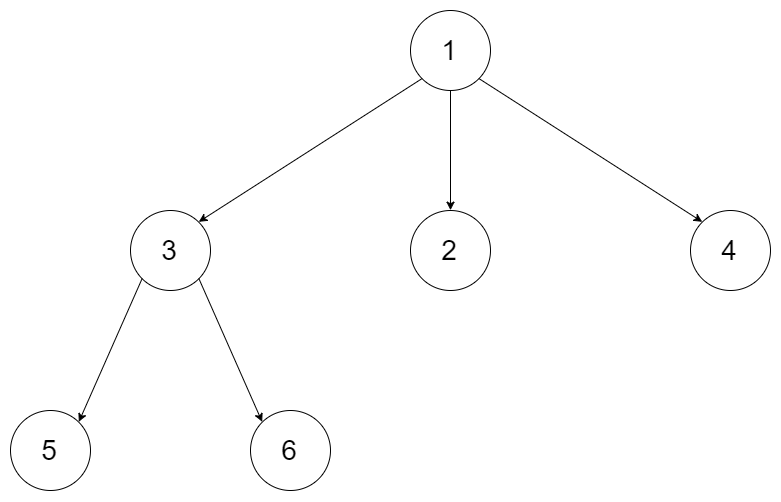
Input: root = [1,null,3,2,4,null,5,6]
Output: [[1],[3,2,4],[5,6]]
Example 2:
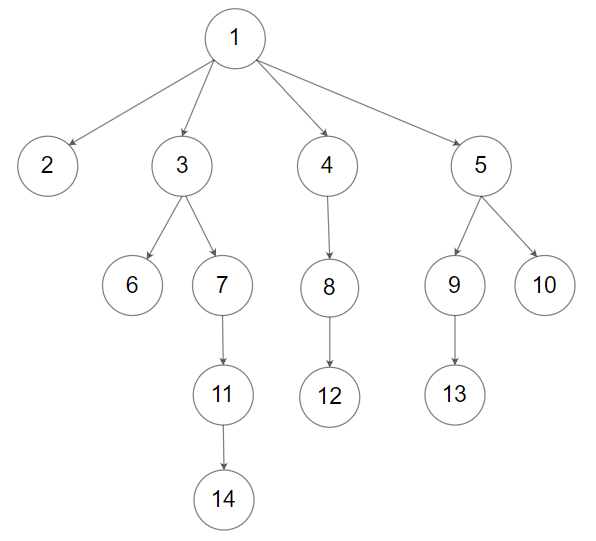
Input: root = [1,null,2,3,4,5,null,null,6,7,null,8,null,9,10,null,null,11,null,12,null,13,null,null,14]
Output: [[1],[2,3,4,5],[6,7,8,9,10],[11,12,13],[14]]
Constraints:
- The height of the n-ary tree is less than or equal to
1000 - The total number of nodes is between
[0, 104]

Solution
Clarifying Questions
When you get asked this question in a real-life environment, it will often be ambiguous (especially at FAANG). Make sure to ask these questions in that case:
- What is the range of values for the `val` attribute within each node?
- Can the n-ary tree be empty or contain only a root node?
- How should the level order traversal be represented? (e.g., a list of lists, where each inner list represents a level)
- If a node has no children (i.e., `children` is empty), should it still be included in its level's list?
- Are we guaranteed that the input tree is a valid n-ary tree, or should I handle potential malformed tree structures?
Brute Force Solution
Approach
We will explore the tree level by level, visiting each node. For each level, we'll gather all the node values before moving on to the next level. This is done without any fancy tricks, simply processing nodes in the order they appear.
Here's how the algorithm would work step-by-step:
- Start at the very top of the tree (the root).
- Visit each of the root's children, recording their values.
- Move to the next level. This means visiting all the children of the nodes we just visited in the previous step.
- Record the values of all these grandchildren.
- Repeat the process of visiting the children of the nodes on the current level and recording their values.
- Continue this level-by-level exploration until you've visited every node in the entire tree.
Code Implementation
def n_ary_tree_level_order_traversal(root):
    if not root:
        return []

    results = []
    nodes_to_visit = [root]

    # Iterate as long as there are nodes to visit at the current level
    while nodes_to_visit:
        current_level_values = []
        next_level_nodes = []

        # Process all nodes at the current level
        for node in nodes_to_visit:
            current_level_values.append(node.val)

            # Add all children of the current node to the next level list
            if node.children:
                next_level_nodes.extend(node.children)

        results.append(current_level_values)

        # Update the list of nodes to visit for the next level
        nodes_to_visit = next_level_nodes

return resultsBig(O) Analysis
Optimal Solution
Approach
The best way to visit all nodes at each level of the tree is to process level by level. We'll use a method that explores nodes in the order they appear, allowing us to group nodes by their level in the tree.
Here's how the algorithm would work step-by-step:
- Begin at the very top of the tree (the root).
- Create a temporary holding area (like a to-do list) to keep track of the nodes we still need to visit, starting by adding the root node to it.
- While the holding area still has nodes in it, this means there are still levels to explore, so repeat the following:
- Create a list to store the nodes at the current level.
- Count how many nodes are currently in the holding area; this represents all nodes at the current level.
- Go through each node in the holding area, one by one. For each node:
- Add the current node to the list of nodes for the current level.
- Look at each of the current node's children (if it has any) and add them to the holding area so that they are visited later.
- Once we've processed all the nodes that were initially in the holding area (the nodes from the current level), add the list of these nodes to a final result list.
- Now the holding area contains the children of the nodes we just processed, so we're ready to move down to the next level.
- Repeat until the holding area is empty, meaning we've visited all the nodes in the tree.
Code Implementation
class Node:
    def __init__(self, val=None, children=None):
        self.val = val
        self.children = children

class Solution:
    def levelOrder(self, root):
        if not root:
            return []

        result_list = []
        nodes_to_visit_queue = [root]

        # Continue as long as there are nodes to process
        while nodes_to_visit_queue:
            current_level_nodes = []
            level_size = len(nodes_to_visit_queue)

            # Iterate through all nodes at the current level
            for _ in range(level_size):
                current_node = nodes_to_visit_queue.pop(0)
                current_level_nodes.append(current_node.val)

                # Add children to queue for next level's processing
                if current_node.children:
                    for child_node in current_node.children:
                        nodes_to_visit_queue.append(child_node)

            # Append the processed level to our result
            result_list.append(current_level_nodes)

return result_listBig(O) Analysis
Edge Cases
| Case | How to Handle |
|---|---|
| Null or empty root node | Return an empty list immediately, as there are no levels to traverse. |
| Root node with no children | Return a list containing only the root node's value in a single level. |
| Tree with only one level (root and direct children) | The algorithm should correctly return a list containing the root's value and then a list of its children's values. |
| Highly unbalanced tree (one very long branch) | BFS handles this case well, ensuring all nodes at each level are processed before moving deeper. |
| Tree with a large number of children per node (high fan-out) | The queue used in BFS needs to be able to efficiently handle a large number of nodes added at each level; ensure adequate memory. |
| Integer overflow if node values are very large | The problem description indicates no specific integer ranges, but consider using a data type with a larger capacity or modulo operation if required. |
| Tree with duplicate node values at different levels | The level order traversal should still correctly list nodes with same values at each level. |
| Deeply nested tree exceeding stack size limit with recursive approach | Use an iterative BFS (breadth-first search) approach to avoid potential stack overflow errors for very deep trees. |






