

N-ary Tree Postorder Traversal
Easy


Given the root of an n-ary tree, return the postorder traversal of its nodes' values.
Nary-Tree input serialization is represented in their level order traversal. Each group of children is separated by the null value (See examples)
Example 1:

Input: root = [1,null,3,2,4,null,5,6]
Output: [5,6,3,2,4,1]
Example 2:
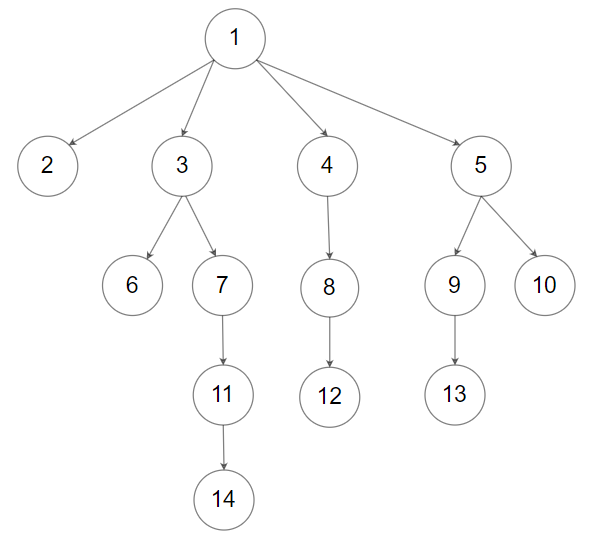
Input: root = [1,null,2,3,4,5,null,null,6,7,null,8,null,9,10,null,null,11,null,12,null,13,null,null,14]
Output: [2,6,14,11,7,3,12,8,4,13,9,10,5,1]
Constraints:
- The number of nodes in the tree is in the range
[0, 104]. 0 <= Node.val <= 104- The height of the n-ary tree is less than or equal to
1000.
Follow up: Recursive solution is trivial, could you do it iteratively?

Solution
Clarifying Questions
When you get asked this question in a real-life environment, it will often be ambiguous (especially at FAANG). Make sure to ask these questions in that case:
- What is the range of values for the 'val' attribute of each node in the N-ary tree?
- Can the N-ary tree be empty (null or contain no nodes)? What should I return in that case?
- What is the maximum number of children a node can have (the 'children' list's maximum size)?
- Is the order of children within a node's 'children' list significant for the postorder traversal, or can I assume it's arbitrary?
- Should I return the list of node values as integers or strings?
Brute Force Solution
Approach
The brute force approach to traversing a tree in postorder means we want to visit all the children of a node before visiting the node itself. To do this the brute force way, we will explore all possibilities of visiting the children first, one by one.
Here's how the algorithm would work step-by-step:
- Start with the root of the tree.
- For each child of the root, completely traverse that child's entire subtree in postorder.
- To traverse a subtree in postorder, repeat the above step for each child of the current node in that subtree.
- Once you've traversed all the children of a particular node, then and only then visit that node itself.
- Continue this process until every node in the entire tree has been visited.
Code Implementation
def n_ary_tree_postorder_traversal(root):
    results = []

    def traverse_node(node):
        if not node:
            return

        # Traverse each child's subtree before visiting the node
        if node.children:

            for child_node in node.children:

                traverse_node(child_node)

        # Append the node's value after visiting all children
        results.append(node.val)

    traverse_node(root)

return resultsBig(O) Analysis
Optimal Solution
Approach
To traverse an N-ary tree in postorder, we need to visit all the children of a node before visiting the node itself. A good way to do this is by using a temporary storage space (like a to-do list) to keep track of nodes we still need to visit.
Here's how the algorithm would work step-by-step:
- Start with the root node of the tree.
- Put the root node in your temporary storage space.
- While your temporary storage space is not empty, take the last node you added from it.
- Check if the node has any children that you have not visited yet.
- If it has unvisited children, add all those children to your temporary storage space, making sure to add the leftmost child last.
- If the node has no unvisited children, it means you have visited all its children. Add the node's value to your final result list.
- Repeat steps 3-6 until your temporary storage space is empty.
- The final result list will contain the values of the nodes in postorder.
Code Implementation
class Node:
    def __init__(self, val=None, children=None):
        self.val = val
        self.children = children

def postorder_traversal(root):
    if not root:
        return []

    result_list = []
    nodes_to_visit = [root]

    while nodes_to_visit:
        current_node = nodes_to_visit.pop()

        # Check if the current node has unvisited children
        if current_node.children:
            children = current_node.children
            nodes_to_visit.append(current_node)
            # Add children in reverse order for correct processing.
            for child in reversed(children):
                nodes_to_visit.append(child)
        else:
            # Add node to the result because its children are visited
            result_list.append(current_node.val)

return result_listBig(O) Analysis
Edge Cases
| Case | How to Handle |
|---|---|
| Null or empty root node | Return an empty list if the root is null or empty, indicating an empty tree. |
| Root node with no children | Return a list containing only the root node's value, as it's the only node to traverse. |
| Very deep tree (high recursion depth) | Consider using an iterative approach (stack-based) to avoid potential stack overflow errors. |
| Tree with a very large number of nodes (memory constraints) | Ensure the chosen data structures (like the list to store the result) can handle the large number of node values without excessive memory usage. |
| Tree with a very wide branching factor (many children per node) | The solution should efficiently iterate through all the children of each node. |
| Integer overflow in node values (if applicable) | If node values are integers, consider the possibility of overflow during calculations (if any are needed beyond simple traversal) and use appropriate data types or checks. |
| Tree with duplicate node values | The traversal order is not affected by duplicate values, so the algorithm should produce a correct postorder traversal regardless. |
| N-ary tree with disconnected subtrees (not a single connected component from the root) | The algorithm assumes the input is a single, connected N-ary tree stemming from the root; disconnected subtrees will not be traversed. |






