

Out of Boundary Paths
Medium



There is an m x n grid with a ball. The ball is initially at the position [startRow, startColumn]. You are allowed to move the ball to one of the four adjacent cells in the grid (possibly out of the grid crossing the grid boundary). You can apply at most maxMove moves to the ball.
Given the five integers m, n, maxMove, startRow, startColumn, return the number of paths to move the ball out of the grid boundary. Since the answer can be very large, return it modulo 109 + 7.
Example 1:

Input: m = 2, n = 2, maxMove = 2, startRow = 0, startColumn = 0
Output: 6
Example 2:
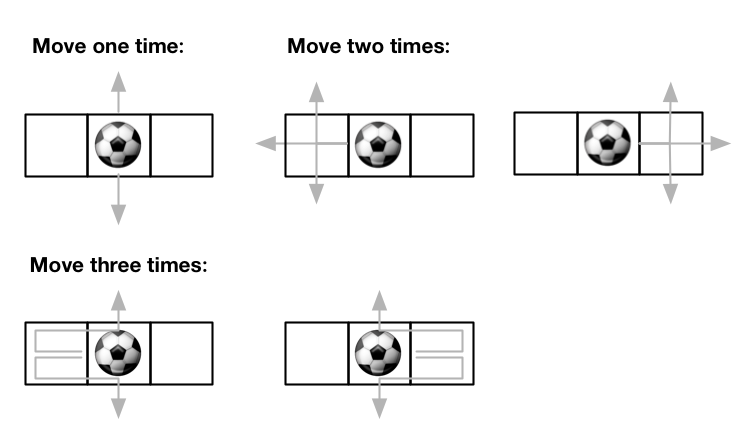
Input: m = 1, n = 3, maxMove = 3, startRow = 0, startColumn = 1
Output: 12
Constraints:
1 <= m, n <= 500 <= maxMove <= 500 <= startRow < m0 <= startColumn < n

Solution
Clarifying Questions
When you get asked this question in a real-life environment, it will often be ambiguous (especially at FAANG). Make sure to ask these questions in that case:
- What are the constraints on m, n, and maxMove? Specifically, what are the maximum possible values for each?
- Are m and n guaranteed to be greater than zero?
- If after maxMove moves, the ball hasn't left the grid, what value should I return?
- Can startRow or startColumn be outside the bounds of the grid initially?
- Should the result be returned modulo a specific number to prevent integer overflow, and if so, what number?
Brute Force Solution
Approach
The brute force way to solve this problem is like trying every single possible path the ball can take. We explore each move the ball can make until it goes out of bounds or runs out of moves.
Here's how the algorithm would work step-by-step:
- Start the ball at its initial position.
- For each possible move the ball can make (up, down, left, right), imagine making that move and finding the ball in its new position.
- If the ball goes out of bounds, count that as one successful path.
- If the ball hasn't gone out of bounds yet but has made all its allowed moves, then that's not a successful path.
- If the ball is still within bounds and has moves remaining, repeat the process: consider all possible moves from this new position.
- Keep doing this, exploring every possible sequence of moves until either the ball goes out of bounds or it runs out of moves.
- Finally, count all the paths that led to the ball going out of bounds. That's our answer.
Code Implementation
def find_out_of_boundary_paths_brute_force(
        grid_rows, grid_columns, max_move_count,
        start_row, start_column):
    number_of_out_of_boundary_paths = 0

    def explore_paths(
            current_row, current_column,
            remaining_moves):
        nonlocal number_of_out_of_boundary_paths

        # If out of bounds, increment paths and return.
        if current_row < 0 or current_row >= grid_rows \
                or current_column < 0 or current_column >= grid_columns:
            number_of_out_of_boundary_paths += 1
            return

        if remaining_moves == 0:
            return

        # Explore all four possible directions recursively.
        explore_paths(
            current_row + 1, current_column,
            remaining_moves - 1)

        explore_paths(
            current_row - 1, current_column,
            remaining_moves - 1)

        # Check each possible direction.
        explore_paths(
            current_row, current_column + 1,
            remaining_moves - 1)

        explore_paths(
            current_row, current_column - 1,
            remaining_moves - 1)

    # Initiate the recursive search.
    explore_paths(start_row, start_column, max_move_count)

return number_of_out_of_boundary_pathsBig(O) Analysis
Optimal Solution
Approach
The most efficient way to solve this problem is to use a method that remembers the results of previous calculations. Instead of recalculating the same paths multiple times, we store and reuse those values.
Here's how the algorithm would work step-by-step:
- Imagine each spot on the grid and how many ways you can get out of bounds from that spot within a certain number of moves.
- Start by figuring out how many ways you can get out of bounds from each spot with just one move. Store those answers.
- Now, for each additional move, look at each spot on the grid. Figure out how many ways you can get out of bounds from that spot by adding up the ways you could have gotten out of bounds from the spots next to it in the previous move.
- Importantly, use the answers you already calculated from the previous moves. Don't recalculate them.
- Keep doing this for each move, building upon the previous answers until you reach the maximum number of moves allowed.
- The final answer is the number of ways you could have gotten out of bounds from the starting spot, which you calculated step by step.
Code Implementation
def find_number_of_paths(grid_rows, grid_columns, max_moves, start_row, start_column):
    modulo = 10**9 + 7
    # ways_to_go_out_of_bounds[i][j] represents number of ways
    # to go out of bounds from cell (i, j) with current moves.
    ways_to_go_out_of_bounds = [[0] * grid_columns for _ in range(grid_rows)]
    ways_to_go_out_of_bounds[start_row][start_column] = 1
    total_paths = 0

    # Build up the solution move by move.
    for move_count in range(1, max_moves + 1):
        # Store values of the previous step to avoid modification issues.
        temp_ways_to_go_out_of_bounds = [[0] * grid_columns for _ in range(grid_rows)]

        for row_index in range(grid_rows):
            for column_index in range(grid_columns):

                # Calculate paths going out of bounds from neighbors.
                for delta_row, delta_column in [(0, 1), (0, -1), (1, 0), (-1, 0)]:
                    neighbor_row = row_index + delta_row
                    neighbor_column = column_index + delta_column

                    if 0 <= neighbor_row < grid_rows and 0 <= neighbor_column < grid_columns:
                        # Accumulate ways to reach current cell from valid neighbors
                        temp_ways_to_go_out_of_bounds[row_index][column_index] = (temp_ways_to_go_out_of_bounds[row_index][column_index] + ways_to_go_out_of_bounds[neighbor_row][neighbor_column]) % modulo

                    else:
                        # Increment total paths if a neighbor is out of bounds
                        total_paths = (total_paths + ways_to_go_out_of_bounds[row_index][column_index]) % modulo

        # Use temp to avoid modifying and reusing the same array.
        ways_to_go_out_of_bounds = temp_ways_to_go_out_of_bounds

    # The result is the final accumulated number of paths.
return total_pathsBig(O) Analysis
Edge Cases
| Case | How to Handle |
|---|---|
| m or n is zero | Return 0, as a grid with zero rows or columns cannot have valid paths. |
| maxMove is zero | Return 0, as no moves are possible to go out of bounds. |
| m, n, and maxMove are all 1 | Check if startRow or startColumn are out of bounds, if not, result is 4. |
| Integer overflow with large m, n, or maxMove when calculating paths. | Use modulo arithmetic (10^9 + 7) to prevent integer overflow during path calculation. |
| Very large maxMove, possibly leading to excessive recursion depth if a recursive approach is used. | Use dynamic programming (memoization or tabulation) to avoid recalculating the same paths and control memory usage. |
| startRow or startColumn is negative or greater or equal to m or n, respectively | Return 0, start position outside of the matrix dimensions |
| m and n are very small, but maxMove is very large | The solution should efficiently handle a large number of moves even when the grid size is small using dynamic programming. |
| m and n are large (close to the constraint limit) and maxMove is also large | Ensure memory usage for the dynamic programming table is optimized to avoid memory limit exceeded errors. |






