

Plates Between Candles
Medium



There is a long table with a line of plates and candles arranged on top of it. You are given a 0-indexed string s consisting of characters '*' and '|' only, where a '*' represents a plate and a '|' represents a candle.
You are also given a 0-indexed 2D integer array queries where queries[i] = [lefti, righti] denotes the substring s[lefti...righti] (inclusive). For each query, you need to find the number of plates between candles that are in the substring. A plate is considered between candles if there is at least one candle to its left and at least one candle to its right in the substring.
- For example,
s = "||**||**|*", and a query[3, 8]denotes the substring"*||**|". The number of plates between candles in this substring is2, as each of the two plates has at least one candle in the substring to its left and right.
Return an integer array answer where answer[i] is the answer to the ith query.
Example 1:

Input: s = "**|**|***|", queries = [[2,5],[5,9]]
Output: [2,3]
Explanation:
- queries[0] has two plates between candles.
- queries[1] has three plates between candles.
Example 2:
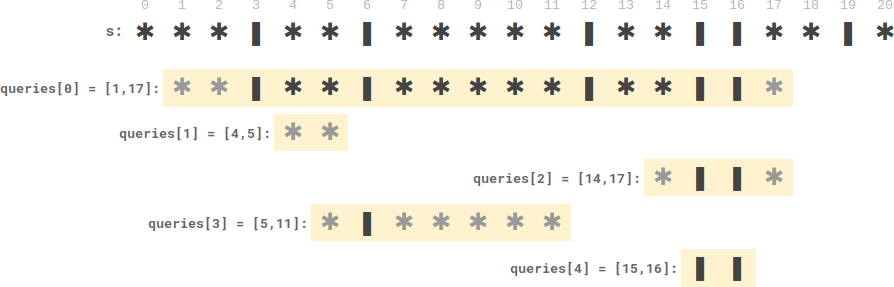
Input: s = "***|**|*****|**||**|*", queries = [[1,17],[4,5],[14,17],[5,11],[15,16]]
Output: [9,0,0,0,0]
Explanation:
- queries[0] has nine plates between candles.
- The other queries have zero plates between candles.
Constraints:
3 <= s.length <= 105sconsists of'*'and'|'characters.1 <= queries.length <= 105queries[i].length == 20 <= lefti <= righti < s.length

Solution
Clarifying Questions
When you get asked this question in a real-life environment, it will often be ambiguous (especially at FAANG). Make sure to ask these questions in that case:
- What is the maximum length of the string `s` and the number of queries in the `queries` array? Are there any constraints on the values within the `queries`?
- Can the string `s` be empty or contain characters other than '*' and '|'?
- If a query range doesn't contain any candles, or contains no plates between any candles, what should the result be?
- Are the query ranges in the `queries` array guaranteed to be valid (i.e., start index less than or equal to end index and within the bounds of the string length)?
- If multiple candles are adjacent, how do we determine the 'nearest' candle for counting the plates in between?
Brute Force Solution
Approach
The brute force method is like counting everything one-by-one to get the answer. For this problem, we examine every possible section between two points and check if it fits our needs.
Here's how the algorithm would work step-by-step:
- For each query, examine every possible segment within the given range.
- For each segment, count the number of plates between the two candles that define the segment.
- Save the count of plates for each segment.
- After checking every segment, return the saved count of plates for that particular query.
Code Implementation
def platesBetweenCandlesBruteForce(stringInput, queries):
    results = []
    for query in queries:
        start = query[0]
        end = query[1]
        queryResult = 0

        # Iterate through all possible segments within the query range
        for segmentStart in range(start, end + 1):
            for segmentEnd in range(segmentStart, end + 1):

                # Find the leftmost candle in the segment
                leftCandle = -1
                for index in range(segmentStart, segmentEnd + 1):
                    if stringInput[index] == '|':
                        leftCandle = index
                        break

                # Find the rightmost candle in the segment
                rightCandle = -1
                for index in range(segmentEnd, segmentStart - 1, -1):
                    if stringInput[index] == '|':
                        rightCandle = index
                        break

                # Check if two candles were found in this segment
                if leftCandle != -1 and rightCandle != -1 and leftCandle < rightCandle:

                    # Count the plates between the candles
                    plateCount = 0
                    for index in range(leftCandle + 1, rightCandle):
                        if stringInput[index] == '*':
                            plateCount += 1

                    # Add the plates between candles to running total
                    queryResult += plateCount

        results.append(queryResult)

return resultsBig(O) Analysis
Optimal Solution
Approach
The problem asks us to count the number of items between candles in specific sections of a row. The efficient solution avoids recounting items by precalculating helpful information to quickly answer each count request.
Here's how the algorithm would work step-by-step:
- First, scan the entire row once to find the location of every candle. Keep this information handy.
- Next, for every position in the row, calculate and store the position of the nearest candle to the left. Similarly, calculate and store the position of the nearest candle to the right.
- Now, when we get a request to count items between candles in a given section, use the pre-calculated candle positions.
- Find the nearest candle to the right of the start of the section and the nearest candle to the left of the end of the section.
- If the candle on the right of the start appears before the candle to the left of the end, we can calculate the number of items between those candles using the information stored in the beginning.
- If the candles do not appear in the correct order, that section doesn't contain any items between valid candles, so the answer for this section is zero.
Code Implementation
def plates_between_candles(s, queries):
    number_of_positions = len(s)
    candle_positions = []

    for i in range(number_of_positions):
        if s[i] == '|':
            candle_positions.append(i)

    nearest_left = [0] * number_of_positions
    nearest_right = [0] * number_of_positions

    left_candle_position = -1
    for i in range(number_of_positions):
        if s[i] == '|':
            left_candle_position = i
        nearest_left[i] = left_candle_position

    right_candle_position = -1
    for i in range(number_of_positions - 1, -1, -1):
        if s[i] == '|':
            right_candle_position = i
        nearest_right[i] = right_candle_position

    result = []
    for start, end in queries:
        # Find the bounding candles for the range
        left_bounding_candle = nearest_right[start]
        right_bounding_candle = nearest_left[end]

        # Ensure the candles are in the correct order
        if left_bounding_candle == -1 or right_bounding_candle == -1 or left_bounding_candle >= right_bounding_candle:
            result.append(0)
        else:
            # Count the plates between the bounding candles.
            count = 0
            for i in range(left_bounding_candle + 1, right_bounding_candle):
                if s[i] == '*':
                    count += 1
            result.append(count)

return resultBig(O) Analysis
Edge Cases
| Case | How to Handle |
|---|---|
| Empty string s or empty queries array | Return an empty list if either input is empty as no calculations can be performed. |
| String s contains no candles ('|') | Return a list of zeros with the same length as queries, as there are no candles to calculate plates between. |
| String s contains only plates ('*') | Return a list of zeros with the same length as queries, as there are no candles to bound the plates. |
| A query range contains no candles | The number of plates in this case is zero, so return 0 for this specific query. |
| Large input string (close to maximum allowed size) and large number of queries | Precompute the nearest left and right candle positions to avoid repeated scans within the queries and ensure time complexity is efficient. |
| Queries with overlapping or identical ranges | Each query is independent so overlapping or identical ranges do not change the algorithm's logic, simply the same computation being repeated multiple times. |
| String starts or ends with many plates | Precompute the left and right nearest candles to handle these leading/trailing plates and include them when the query range intersects the valid candle range. |
| Integer overflow when calculating the number of plates between candles in very long strings | Use a data type that can accommodate the largest possible number of plates, such as long or long long. |






