

Projection Area of 3D Shapes
Easy
You are given an n x n grid where we place some 1 x 1 x 1 cubes that are axis-aligned with the x, y, and z axes.
Each value v = grid[i][j] represents a tower of v cubes placed on top of the cell (i, j).
We view the projection of these cubes onto the xy, yz, and zx planes.
A projection is like a shadow, that maps our 3-dimensional figure to a 2-dimensional plane. We are viewing the "shadow" when looking at the cubes from the top, the front, and the side.
Return the total area of all three projections.
Example 1:
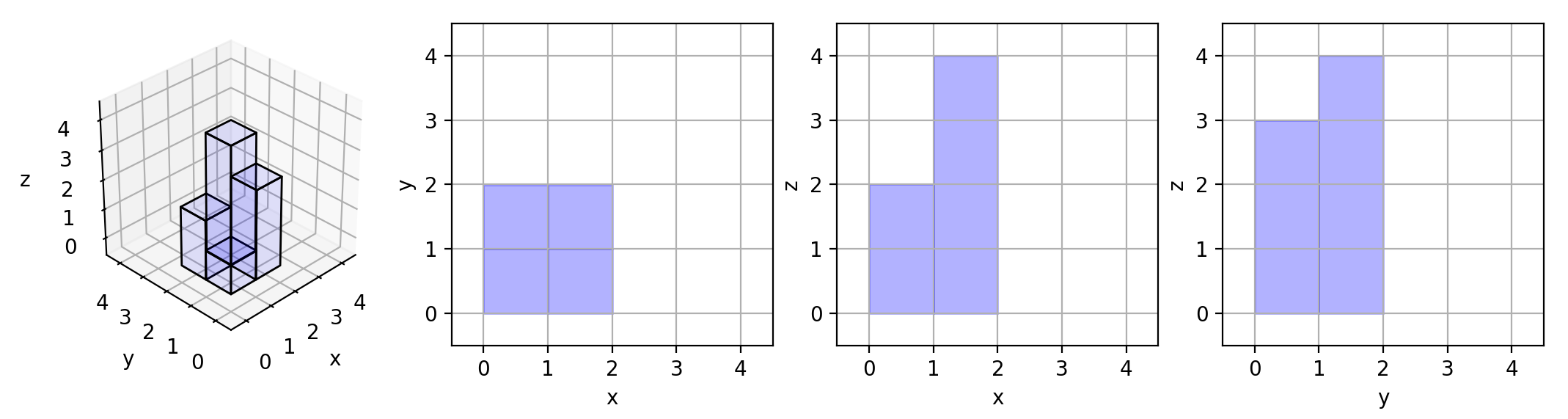
Input: grid = [[1,2],[3,4]]
Output: 17
Explanation: Here are the three projections ("shadows") of the shape made with each axis-aligned plane.
Example 2:
Input: grid = [[2]]
Output: 5
Example 3:
Input: grid = [[1,0],[0,2]]
Output: 8
Constraints:
n == grid.length == grid[i].length1 <= n <= 500 <= grid[i][j] <= 50

Solution
Clarifying Questions
When you get asked this question in a real-life environment, it will often be ambiguous (especially at FAANG). Make sure to ask these questions in that case:
- What are the dimensions of the grid? What is the maximum value of any element in the grid?
- Can the values in the grid be zero, negative, or floating-point numbers?
- If the input grid is empty, what should the function return?
- To clarify, the 'projection area' is the sum of the areas of the shadows cast onto the xy, yz, and xz planes, correct?
- Are there any specific memory constraints or performance considerations I should be aware of, given potentially large grid dimensions?
Brute Force Solution
Approach
Imagine you're shining light on a 3D sculpture from different directions. The brute force method involves figuring out the area of the shadow each light casts by meticulously examining every part of the sculpture. It's like tracing the shadow of each block one by one from each direction.
Here's how the algorithm would work step-by-step:
- First, look at the sculpture from directly above. For each column of blocks, find the height of the tallest block in that column. Add up all those tallest block heights to get the top shadow's area.
- Next, look at the sculpture from the front. For each row of blocks, find the height of the tallest block in that row. Add up all those tallest block heights to get the front shadow's area.
- Finally, look at the sculpture from the side. For each block that's not completely empty space, count it as contributing one unit of area to the side shadow. Add up all the blocks to get the side shadow's area.
- Add the area of the top shadow, the front shadow, and the side shadow together. This total is the projection area of the 3D shape.
Code Implementation
def projection_area_of_3d_shapes(grid):
    number_of_rows = len(grid)
    number_of_columns = len(grid[0])

    top_area = 0
    # Calculate top shadow area
    for column_index in range(number_of_columns):
        max_height_in_column = 0
        for row_index in range(number_of_rows):
            max_height_in_column = max(max_height_in_column, grid[row_index][column_index])
        top_area += max_height_in_column

    front_area = 0
    # Calculate front shadow area
    for row_index in range(number_of_rows):
        max_height_in_row = 0
        for column_index in range(number_of_columns):
            max_height_in_row = max(max_height_in_row, grid[row_index][column_index])
        front_area += max_height_in_row

    side_area = 0
    # Count each non-zero cube as contributing to the side area.
    for row_index in range(number_of_rows):
        for column_index in range(number_of_columns):
            if grid[row_index][column_index] > 0:
                side_area += 1

    total_area = top_area + front_area + side_area
return total_areaBig(O) Analysis
Optimal Solution
Approach
The goal is to find the area of the 3D shape's shadow when projected onto three different planes: the xy-plane, the yz-plane, and the xz-plane. We can calculate each projection area separately and then add them together to get the final answer. The key insight is recognizing what contributes to each of these areas.
Here's how the algorithm would work step-by-step:
- For the projection onto the xy-plane (looking from above), each non-zero cube contributes an area of 1. So, simply count the number of cubes that are present in the grid.
- For the projection onto the yz-plane (looking from the side), find the tallest cube in each row. The height of the tallest cube in each row contributes to the projection area. Sum up these maximum heights for all rows.
- For the projection onto the xz-plane (looking from the front), find the tallest cube in each column. The height of the tallest cube in each column contributes to the projection area. Sum up these maximum heights for all columns.
- Finally, add the three areas you've calculated to obtain the total projection area of the 3D shape.
Code Implementation
def projectionArea(grid):
    xy_area = 0
    yz_area = 0
    xz_area = 0
    number_of_rows = len(grid)
    number_of_cols = len(grid[0]) if number_of_rows > 0 else 0

    # Calculate the projection area onto the xy-plane.
    for row in range(number_of_rows):
        for col in range(number_of_cols):
            if grid[row][col] > 0:
                xy_area += 1

    # Calculate the projection area onto the yz-plane.
    for row in range(number_of_rows):
        max_height_in_row = 0
        for col in range(number_of_cols):
            max_height_in_row = max(max_height_in_row, grid[row][col])
        yz_area += max_height_in_row

    # Calculate the projection area onto the xz-plane.
    for col in range(number_of_cols):
        max_height_in_col = 0
        for row in range(number_of_rows):
            max_height_in_col = max(max_height_in_col, grid[row][col])
        xz_area += max_height_in_col

    # The total projection area is the sum of the three projection areas.
    total_area = xy_area + yz_area + xz_area
return total_areaBig(O) Analysis
Edge Cases
| Case | How to Handle |
|---|---|
| Null or empty input grid | Return 0 if the grid is null or empty, as there is no shape to project. |
| Grid with zero dimensions (e.g., grid[0].length == 0) | Return 0 if either dimension of the grid is zero, indicating an empty shape. |
| Grid with very large dimensions, potentially exceeding memory limits | Ensure the algorithm uses memory efficiently to avoid out-of-memory errors for large grids. |
| Grid containing large integer values that might cause overflow during calculations | Use appropriate data types (e.g., long) or modulo operations to prevent integer overflow. |
| Grid with negative values (invalid for height) | Throw an IllegalArgumentException or return an error code if negative values are encountered, assuming heights cannot be negative. |
| Grid with all zeros (representing an empty shape) | Return 0, indicating that the projection area is zero for an empty shape. |
| Grid where all values are identical (e.g., all cells have height 1) | The algorithm should still compute the correct projection area, which would be rows * cols + rows + cols. |
| Integer overflow in sum of max values | Use long to store the sum of max values for rows and columns to avoid overflow. |






