

Reverse Nodes in k-Group
Reverse Nodes in k-Group #2 Most Asked
Hard
Given the head of a linked list, reverse the nodes of the list k at a time, and return the modified list.
k is a positive integer and is less than or equal to the length of the linked list. If the number of nodes is not a multiple of k then left-out nodes, in the end, should remain as it is.
You may not alter the values in the list's nodes, only nodes themselves may be changed.
Example 1:

Input: head = [1,2,3,4,5], k = 2
Output: [2,1,4,3,5]
Example 2:
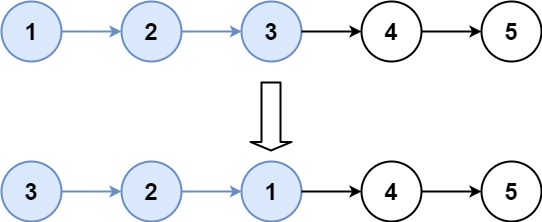
Input: head = [1,2,3,4,5], k = 3
Output: [3,2,1,4,5]
Constraints:
- The number of nodes in the list is
n. 1 <= k <= n <= 50000 <= Node.val <= 1000
Follow-up: Can you solve the problem in O(1) extra memory space?

Solution
Clarifying Questions
When you get asked this question in a real-life environment, it will often be ambiguous (especially at FAANG). Make sure to ask these questions in that case:
- What should be returned if the linked list is empty or if $k$ is greater than the total number of nodes in the list?
- Can $k$ be less than 1, and if so, how should the function behave?
- Are the node values guaranteed to be standard integers, and can they contain duplicates or negative numbers?
- Should the reversal be performed in-place using constant extra space ($O(1)$ auxiliary memory), or is recursion stack space allowed?
- If the total number of nodes is not a multiple of $k$, do the leftover nodes at the end remain in their original relative order?
Brute Force Solution
Approach
Imagine you have a chain of linked items and you want to flip every small group of a specific size. The brute force strategy involves walking through the entire chain to find each small group and meticulously flipping the items inside it, starting from the very beginning.
Here's how the algorithm would work step-by-step:
- Start by looking at the very first item in the chain.
- Count forward by the required group size to see if you have a complete group to flip.
- If you do not have enough items left to make a full group, leave the remaining items exactly as they are.
- If you do have a full group, carefully reverse the connections between the items inside this specific group so they point backward.
- Carefully reconnect the newly flipped group to the rest of the chain.
- Move past the group you just finished flipping and repeat the counting and flipping process for the next group.
- Keep repeating this process until you reach the end of the entire chain.
Code Implementation
class ListNode:
    def __init__(self, item_value=0, next_node=None):
        self.item_value = item_value
        self.next_node = next_node

def reverse_k_group(head_node, group_size):
    current_node = head_node
    group_counter = 0

    # We check if there are at least k nodes remaining to form a valid group for reversal
    while current_node and group_counter < group_size:
        current_node = current_node.next_node
        group_counter += 1

    if group_counter == group_size:
        current_node = reverse_k_group(current_node, group_size)

        # We reverse the current group of nodes since we confirmed we have a full group
        while group_counter > 0:
            next_element = head_node.next_node
            head_node.next_node = current_node
            current_node = head_node
            head_node = next_element
            group_counter -= 1

        head_node = current_node

    # We return the original head if a full group could not be formed, leaving tail untouched
return head_nodeBig(O) Analysis
Optimal Solution
Approach
The optimal approach solves this problem by processing the line of connected items in small, fixed-size chunks. It carefully reverses the direction of pointers within each chunk one by one, while keeping track of where the next chunk begins so nothing gets lost.
Here's how the algorithm would work step-by-step:
- Look at the very beginning of the line of items and check ahead to see if there is a complete group of the required size waiting to be processed.
- If there are not enough items left to form a complete group, leave the remaining items exactly as they are and finish the process.
- If a complete group is found, prepare to reverse the connections between the items inside this specific group.
- Carefully flip the direction of the links between the items one by one, making the last item in the group point backward to the first.
- Connect the newly flipped group to the part of the line that was already processed behind it.
- Remember to connect the start of this flipped group to the rest of the upcoming items ahead.
- Shift your attention forward to the next section of the line and repeat the entire process until no complete groups are left.
Code Implementation
Big(O) Analysis
Edge Cases
| Case | How to Handle |
|---|---|
| Null head or empty linked list | Return the head immediately without performing any operations since no nodes exist to reverse. |
| k is equal to 1 | Return the original head unchanged because reversing groups of one node leaves the list identical. |
| k is greater than the total number of nodes in the list | Leave the entire list unmodified and return the head as the node count is less than k. |
| Total number of nodes is an exact multiple of k | Process and reverse every single group successfully without leaving any trailing nodes behind. |
| List length is smaller than k | Check the remaining node count before each reversal attempt and keep the tail nodes as they are if they fall short of k. |
| k equals the exact length of the linked list | Reverse the entire linked list from the head to the tail and return the new head as the final result. |
| Nodes contain duplicate values, negative numbers, or extreme values | Ignore node values entirely and only manipulate the pointer references to ensure values do not affect pointer logic. |
| Large linked list approaching memory constraints | Use an iterative approach with O(1) extra space to prevent stack overflow errors that recursion might cause. |






