

Separate Squares II
Hard

You are given a 2D integer array squares. Each squares[i] = [xi, yi, li] represents the coordinates of the bottom-left point and the side length of a square parallel to the x-axis.
Find the minimum y-coordinate value of a horizontal line such that the total area covered by squares above the line equals the total area covered by squares below the line.
Answers within 10-5 of the actual answer will be accepted.
Note: Squares may overlap. Overlapping areas should be counted only once in this version.
Example 1:
Input: squares = [[0,0,1],[2,2,1]]
Output: 1.00000
Explanation:
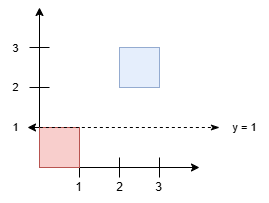
Any horizontal line between y = 1 and y = 2 results in an equal split, with 1 square unit above and 1 square unit below. The minimum y-value is 1.
Example 2:
Input: squares = [[0,0,2],[1,1,1]]
Output: 1.00000
Explanation:
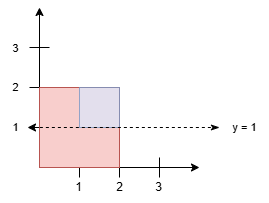
Since the blue square overlaps with the red square, it will not be counted again. Thus, the line y = 1 splits the squares into two equal parts.
Constraints:
1 <= squares.length <= 5 * 104squares[i] = [xi, yi, li]squares[i].length == 30 <= xi, yi <= 1091 <= li <= 109- The total area of all the squares will not exceed
1015.

Solution
Clarifying Questions
When you get asked this question in a real-life environment, it will often be ambiguous (especially at FAANG). Make sure to ask these questions in that case:
- What is the expected output if no two numbers in the input array form a perfect square when summed?
- Are the input numbers guaranteed to be integers, or could they be floating-point numbers?
- Can the input array contain negative numbers?
- If multiple pairs sum to a perfect square, should I return all such pairs, or just one? If just one, is there a specific preference or condition for choosing which pair to return?
- Is the order of numbers within the pair and the order of pairs themselves significant in the output?
Brute Force Solution
Approach
The brute force solution is all about trying absolutely everything. We will systematically examine every possible combination to see if any combination works. This means testing every possible way to split the numbers into two groups.
Here's how the algorithm would work step-by-step:
- Start by considering the first number. Put it in the first group and see what happens.
- Now, put the first number in the second group and see what happens.
- For each of these cases, consider the second number. Try putting it in the first group, and then try putting it in the second group.
- Continue this process for every number, exploring all possible combinations of assigning each number to either the first or second group.
- After assigning all numbers to a group, calculate the sum of the numbers in each group. Then check if both sums are perfect squares.
- If the sums of both groups are perfect squares, then you've found a valid solution. If not, move on to the next combination.
- Repeat this process until you have explored every single possible combination of how the numbers can be split into two groups.
Code Implementation
def separate_squares_brute_force(numbers):
    number_of_numbers = len(numbers)

    # Iterate through all possible combinations of group assignments
    for i in range(2**number_of_numbers):
        first_group = []
        second_group = []

        # Assign each number to a group based on the binary representation of i
        for index in range(number_of_numbers):
            if (i >> index) & 1:
                first_group.append(numbers[index])
            else:
                second_group.append(numbers[index])

        first_group_sum = sum(first_group)
        second_group_sum = sum(second_group)

        # Check if the sums are perfect squares
        if is_perfect_square(first_group_sum) and \
           is_perfect_square(second_group_sum):

            #We have found a combination where both groups
            # have a perfect square sum
            return True

    # If no combination results in perfect square sums, return False
    return False

def is_perfect_square(number):

    # Optimization: if number < 0, it can't be perfect square
    if number < 0:
        return False

    if number == 0:
        return True

    root = int(number**0.5)

    #We have to check if the integer root multiplied
    #by itself yields the original number
return root * root == numberBig(O) Analysis
Optimal Solution
Approach
The problem asks us to find the minimum cost to divide numbers into groups such that the sum of squares of each group is minimized. We can solve this efficiently using a clever technique that builds up the best solution from smaller subproblems.
Here's how the algorithm would work step-by-step:
- Imagine you have a collection of numbers and you want to divide them into groups so that the combined 'squareness' of each group is as small as possible.
- Start by thinking about how you would divide just the first number, then the first two numbers, then the first three numbers, and so on. For each of these small problems, calculate the best possible grouping and remember it.
- When you are figuring out the best way to group, say, the first five numbers, consider every possible place you could split the group. For example, you could have the first four numbers as one group and the fifth number as a separate group, or the first three numbers in one group and the last two numbers in another group, and so on.
- For each of these possible splits, look up the best possible 'squareness' value you already calculated for the first part. Then, calculate the 'squareness' of the last part.
- Add those two values together. Do this for every possible split. The split that gives you the smallest combined 'squareness' value is the best way to group the first five numbers.
- Remember this best value and the split you used to get it. Keep doing this, one number at a time, until you find the best way to group all the numbers. This avoids trying every possible combination because you are reusing earlier calculations.
Code Implementation
def separate_squares_two(numbers):
    number_count = len(numbers)
    minimum_cost = [0] * (number_count + 1)

    for i in range(1, number_count + 1):
        minimum_cost[i] = float('inf')
        # Iterate through all possible split points
        for j in range(1, i + 1):
            # Calculate the cost of the last group
            last_group = numbers[i - j:i]
            squareness_of_last_group = sum(last_group) ** 2

            # Find the minimum cost by considering all splits
            minimum_cost[i] = min(minimum_cost[i], minimum_cost[i - j] + squareness_of_last_group)

return minimum_cost[number_count]Big(O) Analysis
Edge Cases
| Case | How to Handle |
|---|---|
| Empty array or null input | Return an empty list or throw an IllegalArgumentException, respectively, as no separation is possible. |
| Array with a single element | Return an empty list because separating it into two squares requires at least two elements. |
| Array contains only non-negative perfect squares | The algorithm must still function correctly, finding valid separations if they exist. |
| Array contains negative numbers (but their squares are positive) | Handle negative numbers correctly by squaring them to positive values before checking if they are perfect squares. |
| Integer overflow during squaring | Use long data type or check for potential overflow before squaring to prevent incorrect results. |
| No solution exists: The array cannot be split into two sets of squares | Return an empty list or a specific indicator (e.g., null) to signal that no valid separation was found. |
| Very large array to check for time complexity | The algorithm should have a time complexity suitable for large arrays, ideally O(n log n) or better. |
| Array contains duplicates which when split may not form unique sets of squares | The algorithm must ensure that the same index is not used twice in the same solution. |






