

Serialize and Deserialize N-ary Tree
Hard





Serialization is the process of converting a data structure or object into a sequence of bits so that it can be stored in a file or memory buffer, or transmitted across a network connection link to be reconstructed later in the same or another computer environment.
Design an algorithm to serialize and deserialize an N-ary tree. An N-ary tree is a rooted tree in which each node has no more than N children. There is no restriction on how your serialization/deserialization algorithm should work. You just need to ensure that an N-ary tree can be serialized to a string and this string can be deserialized to the original tree structure.
For example, you may serialize the following 3-ary tree
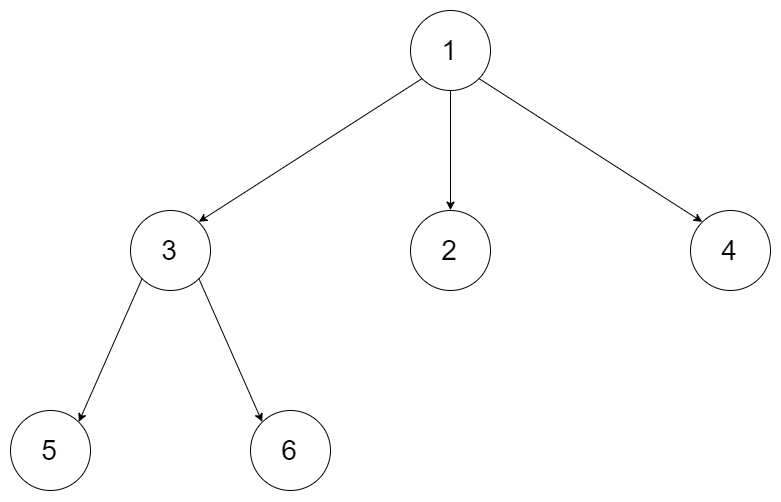
as [1 [3[5 6] 2 4]]. You do not necessarily need to follow this format, so please be creative and come up with different approaches yourself.
Note: N is in the range of [1, 1000]
An N-ary tree is encoded as a string consisting of the values of nodes and an indication of the number of children for each node.
Example 1:
Input: root = [1,null,2,3,4,5,null,null,6,7,null,8,null,9,10,null,null,11,null,12,null,13,null,null,14]
Output: [1,null,2,3,4,5,null,null,6,7,null,8,null,9,10,null,null,11,null,12,null,13,null,null,14]
Example 2:
Input: root = [1,null,3,2,4,null,5,6]
Output: [1,null,3,2,4,null,5,6]
Example 3:
Input: root = []
Output: []
Constraints:
- The height of the n-ary tree is less than or equal to
1000 - The total number of nodes is between
[0, 104] - Do not use class member/global/static variables to store states. Your encode and decode algorithms should be stateless.

Solution
Clarifying Questions
When you get asked this question in a real-life environment, it will often be ambiguous (especially at FAANG). Make sure to ask these questions in that case:
- What data type are the node values? Are they integers, strings, or something else, and are there any restrictions on the range of values?
- How should I represent an empty tree or a null node in the serialized string?
- Is the order of children in the serialized string significant for deserialization? Should I preserve the original order during serialization and deserialization?
- Are there any constraints on the depth or branching factor (maximum number of children) of the N-ary tree?
- Should I handle potential issues like malformed serialized strings, and if so, how (e.g., throw an exception or return null)?
Brute Force Solution
Approach
Let's imagine we need to turn a tree structure into a simple string and back again. The brute force way to do this is to explore every possible way to represent the tree as a string and then check each representation during deserialization.
Here's how the algorithm would work step-by-step:
- For serialization, start with the root of the tree.
- Consider every possible order you could list the children of that root within the string representation.
- For each of those orderings, recursively do the same for each child, exploring all orderings of their children, and so on.
- This creates a huge set of possible string representations of the tree.
- For deserialization, when you get a string, try to break it down into the root and a list of child trees in every conceivable way.
- For each potential child list, recursively try to deserialize each part to make a child node.
- If you find a way to break down the string into a valid root and valid children, you've successfully deserialized it.
- Keep trying different breakdowns until you find one that works, or until you've exhausted all possibilities.
Code Implementation
class Node:
    def __init__(self, val):
        self.val = val
        self.children = []

def serialize_n_ary_tree_brute_force(root):
    if not root:
        return "#"

    serialized_data = str(root.val) + ","
    children_representations = []

    for child in root.children:
        children_representations.append(serialize_n_ary_tree_brute_force(child))

    serialized_data += "[" + ",".join(children_representations) + "]"
    return serialized_data

def deserialize_n_ary_tree_brute_force(data):
    def find_all_possible_trees(data):
        if data == "#":
            return [(None, "")]

        possible_trees = []
        #Try splitting string into root and children in every way.
        for i in range(len(data)):
            if data[i] == ",":
                root_value = int(data[:i])
                remaining_data = data[i+1:]
                if remaining_data.startswith("[") and remaining_data.endswith("]"):
                    child_data = remaining_data[1:-1]
                    if not child_data:
                        possible_trees.append((Node(root_value), ""))
                    else:
                        possible_child_trees = [[]]
                        current_child_data = ""
                        open_brackets = 0

                        for char_index, character in enumerate(child_data):
                            if character == "," and open_brackets == 0:
                                next_possible_child_trees = []

                                for current_tree_list in possible_child_trees:
                                    for possible_tree, remaining in find_all_possible_trees(current_child_data):
                                        if possible_tree is not None:
                                            next_possible_child_trees.append(current_tree_list + [possible_tree])
                                current_child_data = ""
                                possible_child_trees = next_possible_child_trees

                            elif character == '[':
                                open_brackets += 1
                                current_child_data += character
                            elif character == ']':
                                open_brackets -= 1
                                current_child_data += character
                            else:
                                current_child_data += character

                        next_possible_child_trees = []
                        for current_tree_list in possible_child_trees:
                            for possible_tree, remaining in find_all_possible_trees(current_child_data):
                                if possible_tree is not None:
                                    next_possible_child_trees.append(current_tree_list + [possible_tree])
                        possible_child_trees = next_possible_child_trees

                        #Create root with all combinations of children
                        for children_list in possible_child_trees:
                            root_node = Node(root_value)
                            root_node.children = children_list
                            possible_trees.append((root_node, ""))
                break
        return possible_trees

    # Return tree if a valid deserialization is found.
    possible_trees = find_all_possible_trees(data)
    if possible_trees:
        return possible_trees[0][0]
    else:
return NoneBig(O) Analysis
Optimal Solution
Approach
To store and retrieve an N-ary tree, we'll represent its structure using a string. The core idea is to walk through the tree, encoding the relationships between parents and children, and then reverse the process to rebuild the tree from the string.
Here's how the algorithm would work step-by-step:
- When saving the tree to a string, start at the root and go through each level one by one.
- For each node, record its value and the number of children it has.
- Use a special marker, like a comma, to separate the node's value and number of children, and another marker, like a parenthesis, to separate one node's information from the next.
- When the algorithm comes across a null node, represent it with a specific string like null to avoid losing any information. This is especially important for re-constructing the tree correctly.
- When loading the tree from a string, first split the string into individual node representations using the parenthesis marker.
- Start by creating the root node from the first part of the string, using the first marker to seperate node value and number of children.
- Then, recursively create its children, using the number of children information to figure out how many children each node has in the string.
- Keep going through the parts of the string, creating the nodes and their connections to rebuild the entire tree structure from top to bottom.
- The 'null' nodes will be skipped in this process when the string is parsed.
- By following this step-by-step process, we can accurately save and restore the N-ary tree.
Code Implementation
class Node:
    def __init__(self, value):
        self.value = value
        self.children = []

class Solution:
    def serialize(self, root):
        if not root:
            return "null,"

        serialized_string = str(root.value) + "," + str(len(root.children)) + ","

        for child in root.children:
            serialized_string += self.serialize(child)

        return serialized_string

    def deserialize(self, data):
        data_list = data.split(",")
        self.index = 0
        return self.deserialize_helper(data_list)

    def deserialize_helper(self, data_list):
        if self.index >= len(data_list) or data_list[self.index] == "null":
            self.index += 1
            return None

        node_value = int(data_list[self.index])
        self.index += 1
        number_of_children = int(data_list[self.index])
        self.index += 1

        node = Node(node_value)

        # Reconstruct children based on the number of children
        for _ in range(number_of_children):
            child = self.deserialize_helper(data_list)
            if child:
                node.children.append(child)

        return node

# Your Codec object will be instantiated and called as such:
# ser = Codec()
# deser = Codec()
# tree = ser.serialize(root)
# ans = deser.deserialize(tree)
# return ansBig(O) Analysis
Edge Cases
| Case | How to Handle |
|---|---|
| Null root node for serialization | Return an empty string or a predefined null representation (e.g., '#') to signify an empty tree. |
| Empty string or null input for deserialization | Return a null root node indicating an empty tree was deserialized. |
| Tree with only a root node | Serialize as the root's value followed by appropriate delimiters, and deserialize accordingly. |
| Very large tree depth, potential stack overflow during recursion | Consider an iterative approach (e.g., using a queue) for serialization/deserialization to avoid exceeding recursion limits. |
| Tree with a very large number of children for a single node | Ensure the delimiter scheme handles variable length child lists efficiently during both serialization and deserialization. |
| Input string with malformed serialized tree representation | Implement robust error checking during deserialization to handle incorrect formatting or missing delimiters, throwing an exception or returning null. |
| Nodes with identical values, ensure correct tree structure after deserialization | Serialization must preserve the order and structure of children even when node values are identical, and deserialization must reconstruct the tree accordingly. |
| Tree containing node values with the same character(s) used as delimiters | Choose delimiters that are guaranteed not to appear in the node values, or use escaping mechanisms if value range is unbounded. |






