

Shortest Path in a Grid with Obstacles Elimination
Hard











You are given an m x n integer matrix grid where each cell is either 0 (empty) or 1 (obstacle). You can move up, down, left, or right from and to an empty cell in one step.
Return the minimum number of steps to walk from the upper left corner (0, 0) to the lower right corner (m - 1, n - 1) given that you can eliminate at most k obstacles. If it is not possible to find such walk return -1.
Example 1:
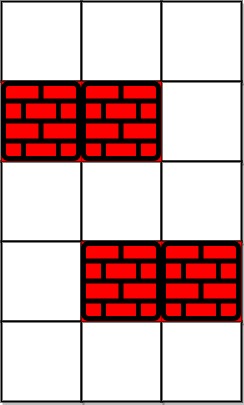
Input: grid = [[0,0,0],[1,1,0],[0,0,0],[0,1,1],[0,0,0]], k = 1
Output: 6
Explanation:
The shortest path without eliminating any obstacle is 10.
The shortest path with one obstacle elimination at position (3,2) is 6. Such path is (0,0) -> (0,1) -> (0,2) -> (1,2) -> (2,2) -> (3,2) -> (4,2).
Example 2:

Input: grid = [[0,1,1],[1,1,1],[1,0,0]], k = 1
Output: -1
Explanation: We need to eliminate at least two obstacles to find such a walk.
Constraints:
m == grid.lengthn == grid[i].length1 <= m, n <= 401 <= k <= m * ngrid[i][j]is either0or1.grid[0][0] == grid[m - 1][n - 1] == 0

Solution
Clarifying Questions
When you get asked this question in a real-life environment, it will often be ambiguous (especially at FAANG). Make sure to ask these questions in that case:
- What are the dimensions of the grid? Specifically, what are the minimum and maximum possible values for 'm' (rows) and 'n' (columns)?
- Is the starting cell (0, 0) and the destination cell (m-1, n-1) guaranteed to be empty cells (0), or could they be obstacles (1)?
- What is the maximum possible value for 'k', the number of obstacles we can eliminate?
- If the starting cell (0,0) is an obstacle, and k is 0, what should be returned?
- Are there any constraints on the values within the grid besides 0 and 1? For instance, can 'k' be negative, or can the grid contain values other than 0 or 1?
Brute Force Solution
Approach
The brute force approach to finding the shortest path is to explore every single possible route from the start to the end. This means trying every combination of moves, even if some are clearly bad choices.
Here's how the algorithm would work step-by-step:
- Start at the beginning point in the grid.
- From the current spot, consider every direction you can move (up, down, left, right).
- For each possible move, check if it's valid (not off the grid, and you have enough ability to break through an obstacle if needed).
- If a move is valid, take that step and mark this new spot as visited for this specific path attempt.
- Now, from this new spot, repeat the process of considering every valid move.
- Continue this exploration, branching out with every possible valid step, until you either reach the end point or run out of valid moves for a particular path.
- If you reach the end point, record the length of that path.
- After exploring all possible branches and paths in this exhaustive way, compare all the recorded path lengths.
- The shortest recorded path length is your answer.
Code Implementation
def shortest_path_brute_force(grid, max_k): rows_in_grid = len(grid) columns_in_grid = len(grid[0]) end_row = rows_in_grid - 1 end_column = columns_in_grid - 1 shortest_path_length = float('inf') # We need to explore all possible paths recursively def explore_paths(current_row, current_column, obstacles_eliminated, path_length, visited_states): nonlocal shortest_path_length # If we go out of bounds, or have visited this exact state before with fewer eliminations, prune this path. if not (0 <= current_row < rows_in_grid and 0 <= current_column < columns_in_grid) or (current_row, current_column, obstacles_eliminated) in visited_states: return visited_states.add((current_row, current_column, obstacles_eliminated)) # If we reached the destination, update the shortest path found so far. if current_row == end_row and current_column == end_column: shortest_path_length = min(shortest_path_length, path_length) return # Check if the current cell is an obstacle is_obstacle = grid[current_row][current_column] == 1 new_obstacles_eliminated = obstacles_eliminated + is_obstacle # Only proceed if we have eliminations left to overcome the obstacle. if new_obstacles_eliminated <= max_k: # Explore all four possible directions: up, down, left, right. possible_moves = [(0, 1), (0, -1), (1, 0), (-1, 0)] for row_change, column_change in possible_moves: next_row = current_row + row_change next_column = current_column + column_change explore_paths(next_row, next_column, new_obstacles_eliminated, path_length + 1, visited_states.copy()) # Start the exploration from the top-left corner with 0 obstacles eliminated and path length 0. explore_paths(0, 0, 0, 0, set()) return shortest_path_length if shortest_path_length != float('inf') else -1Big(O) Analysis
Optimal Solution
Approach
This problem is about finding the quickest way to get from one corner of a grid to another, while being able to remove a limited number of obstacles. The best strategy is to explore possible paths in a smart, expanding manner, prioritizing shorter journeys first.
Here's how the algorithm would work step-by-step:
- Imagine the grid as a map. We start at the top-left corner and want to reach the bottom-right.
- We can move up, down, left, or right to adjacent spots on the map.
- Some spots are blocked by obstacles, but we have a special ability to clear a certain number of these obstacles.
- We want to find the path that uses the fewest steps.
- To do this, we'll explore all possible next steps from our current position, considering how many obstacles we've already cleared.
- We keep track of all the different paths we're currently exploring and how many obstacles each path has used.
- At each step, we prioritize exploring the paths that have taken the fewest overall steps so far.
- If a path reaches a spot we've already visited with fewer or the same number of obstacle removals, we don't need to explore that path further because we've found a better or equal way to get there.
- We continue this exploration, always looking at the shortest paths first, until we reach the destination.
- The first time we reach the destination, we know we've found the shortest possible path because we systematically explored shorter paths before longer ones.
Code Implementation
import collections

def shortest_path_with_obstacles_elimination(grid, maximum_obstacle_removals):
    number_of_rows = len(grid)
    number_of_columns = len(grid[0])
    target_row = number_of_rows - 1
    target_column = number_of_columns - 1

    if number_of_rows == 1 and number_of_columns == 1:
        return 0

    # State: (row, column, remaining_obstacle_removals)
    queue = collections.deque([(0, 0, maximum_obstacle_removals, 0)])
    # Visited set to avoid cycles and redundant computations.
    # Stores (row, column, remaining_obstacle_removals)
    visited_states = set([(0, 0, maximum_obstacle_removals)])

    while queue:
        current_row, current_column, current_removals, current_steps = queue.popleft()

        # Explore possible moves: up, down, left, right
        for delta_row, delta_column in [(0, 1), (0, -1), (1, 0), (-1, 0)]:
            next_row = current_row + delta_row
            next_column = current_column + delta_column

            # Check if the next position is within the grid boundaries
            if 0 <= next_row < number_of_rows and 0 <= next_column < number_of_columns:
                obstacle_present = grid[next_row][next_column] == 1
                remaining_removals_after_move = current_removals - obstacle_present

                # If we have enough removals left for this obstacle or it's not an obstacle
                if remaining_removals_after_move >= 0:
                    # This state represents reaching (next_row, next_column) with remaining removals.
                    # If we have visited this state with more or equal removals, no need to re-explore.
                    next_state = (next_row, next_column, remaining_removals_after_move)
                    if next_state not in visited_states:
                        visited_states.add(next_state)

                        # Check if we have reached the destination
                        if next_row == target_row and next_column == target_column:
                            return current_steps + 1

                        queue.append((next_row, next_column, remaining_removals_after_move, current_steps + 1))

    # If the queue is exhausted and the destination is not reached, no path exists
    return -1
Big(O) Analysis
Edge Cases
| Case | How to Handle |
|---|---|
| Grid is null or empty | The solution should return -1 or throw an exception if the grid is null or has zero rows/columns. |
| Grid is 1x1 | If the grid is 1x1, the starting cell is also the destination, so 0 steps are required. |
| Start or end cell is an obstacle | If the start or end cell is an obstacle and k is 0, it's impossible to reach the destination, return -1. |
| k is greater than or equal to the total number of obstacles | If k is large enough to eliminate all obstacles, the problem simplifies to finding the shortest path in a grid without obstacles. |
| No path exists even with obstacle elimination | The BFS algorithm will naturally exhaust all reachable states, and if the destination is not found, it will return -1. |
| Grid dimensions are very large | The solution should handle large grids by using BFS, which is efficient in terms of time complexity for unweighted graphs, but memory might become an issue for very large k. |
| k is 0 | When k is 0, the path cannot traverse any obstacles, effectively turning it into a standard BFS on a grid with static obstacles. |
| All cells are obstacles | If all cells are obstacles and k is less than the number of cells to traverse, it will be impossible to reach the destination. |






