

Sort Matrix by Diagonals
MediumYou are given an n x n square matrix of integers grid. Return the matrix such that:
- The diagonals in the bottom-left triangle (including the middle diagonal) are sorted in non-increasing order.
- The diagonals in the top-right triangle are sorted in non-decreasing order.
Example 1:
Input: grid = [[1,7,3],[9,8,2],[4,5,6]]
Output: [[8,2,3],[9,6,7],[4,5,1]]
Explanation:
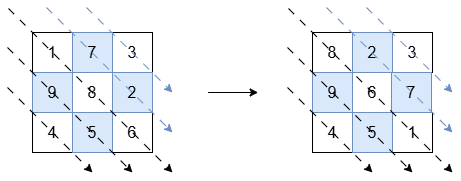
The diagonals with a black arrow (bottom-left triangle) should be sorted in non-increasing order:
[1, 8, 6]becomes[8, 6, 1].[9, 5]and[4]remain unchanged.
The diagonals with a blue arrow (top-right triangle) should be sorted in non-decreasing order:
[7, 2]becomes[2, 7].[3]remains unchanged.
Example 2:
Input: grid = [[0,1],[1,2]]
Output: [[2,1],[1,0]]
Explanation:
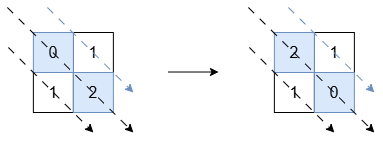
The diagonals with a black arrow must be non-increasing, so [0, 2] is changed to [2, 0]. The other diagonals are already in the correct order.
Example 3:
Input: grid = [[1]]
Output: [[1]]
Explanation:
Diagonals with exactly one element are already in order, so no changes are needed.
Constraints:
grid.length == grid[i].length == n1 <= n <= 10-105 <= grid[i][j] <= 105

Solution
Clarifying Questions
When you get asked this question in a real-life environment, it will often be ambiguous (especially at FAANG). Make sure to ask these questions in that case:
- What are the constraints on the dimensions of the matrix (number of rows and columns)?
- Are the values in the matrix guaranteed to be non-negative integers, or can they include negative numbers or zero?
- Can the matrix be empty, or can individual rows be empty?
- Are there any constraints on the range of integer values within the matrix?
- Is it possible for diagonals to contain duplicate values, and if so, should they maintain their relative order after sorting?
Brute Force Solution
Approach
To sort the matrix by diagonals using a brute force approach, we'll identify all the distinct diagonals and then sort the numbers within each diagonal independently. Finally, we'll place these sorted numbers back into their original diagonal positions.
Here's how the algorithm would work step-by-step:
- First, identify all the diagonals that run from the top-left to the bottom-right of the grid.
- For each identified diagonal, gather all the numbers that belong to it.
- Sort the collected numbers for each diagonal from smallest to largest.
- After sorting all the numbers within each diagonal, carefully put them back into the grid along their respective diagonals, in the new sorted order.
- This process ensures that all numbers on every diagonal are now in ascending order.
Code Implementation
def sort_matrix_by_diagonals_brute_force(matrix):
    rows = len(matrix)
    columns = len(matrix[0])
    diagonals = {}

    # Group elements by their diagonal identifier (row - column)
    for rowIndex in range(rows):
        for columnIndex in range(columns):
            diagonalIdentifier = rowIndex - columnIndex
            if diagonalIdentifier not in diagonals:
                diagonals[diagonalIdentifier] = []
            diagonals[diagonalIdentifier].append(matrix[rowIndex][columnIndex])

    # Sort each diagonal independently
    for diagonalIdentifier in diagonals:
        # Sorting ensures elements are in ascending order for each diagonal
        diagonals[diagonalIdentifier].sort()

    # Place sorted elements back into the matrix
    for rowIndex in range(rows):
        for columnIndex in range(columns):
            diagonalIdentifier = rowIndex - columnIndex
            # Pop from the front of the sorted list to maintain order
            matrix[rowIndex][columnIndex] = diagonals[diagonalIdentifier].pop(0)

return matrixBig(O) Analysis
Optimal Solution
Approach
The most efficient way to sort a matrix by its diagonals is to treat each diagonal as a separate collection of numbers. We can gather all the numbers belonging to a single diagonal, sort that collection, and then place them back onto their original diagonal in the sorted order. Repeating this for every diagonal ensures the entire matrix is sorted correctly.
Here's how the algorithm would work step-by-step:
- Identify all the diagonals that run from the top-left to the bottom-right.
- For each diagonal, gather all the numbers that belong to it.
- Sort the collected numbers for that specific diagonal in ascending order.
- Place the sorted numbers back onto their original diagonal in the matrix.
- Repeat this process for every diagonal in the matrix.
- Once all diagonals have been processed, the entire matrix will be sorted by its diagonals.
Code Implementation
def sort_matrix_by_diagonals(matrix):
    number_of_rows = len(matrix)
    number_of_columns = len(matrix[0])

    # Group elements by diagonal index.
    diagonals_by_identifier = {}

    for row_index in range(number_of_rows):
        for column_index in range(number_of_columns):
            diagonal_identifier = row_index - column_index
            if diagonal_identifier not in diagonals_by_identifier:
                diagonals_by_identifier[diagonal_identifier] = []
            diagonals_by_identifier[diagonal_identifier].append(matrix[row_index][column_index])

    # Sort each collected diagonal.
    for diagonal_identifier in diagonals_by_identifier:
        diagonals_by_identifier[diagonal_identifier].sort()

    # Place sorted elements back into the matrix.
    for row_index in range(number_of_rows):
        for column_index in range(number_of_columns):
            diagonal_identifier = row_index - column_index
            # Ensure correct placement by popping from the sorted list.
            matrix[row_index][column_index] = diagonals_by_identifier[diagonal_identifier].pop(0)

return matrixBig(O) Analysis
Edge Cases
| Case | How to Handle |
|---|---|
| Empty matrix or matrix with zero rows/columns | The solution should gracefully handle an empty matrix by returning it as is, as no operations are possible. |
| Single-row or single-column matrix | Such matrices effectively have only one diagonal each, which the solution should sort correctly. |
| 1x1 matrix | A 1x1 matrix has a single diagonal with one element, which is already sorted and should be returned unchanged. |
| Matrix with all identical values | The sorting logic should still work, placing identical values adjacent to each other within their respective diagonals. |
| Matrix with negative numbers, zeros, or large boundary values | Standard integer sorting algorithms handle these values correctly, so no special handling is needed. |
| Matrix where diagonals have varying lengths | The approach of collecting elements per diagonal and then sorting them handles varying lengths automatically. |
| Very large matrices exceeding memory limits | For extremely large matrices, an in-place sorting approach for each diagonal might be necessary to conserve memory. |
| Rectangular matrices (non-square) | The diagonal definition and sorting logic should apply universally to both square and rectangular matrices. |






