

Spiral Matrix
Medium







































Given an m x n matrix, return all elements of the matrix in spiral order.
Example 1:
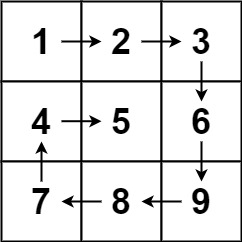
Input: matrix = [[1,2,3],[4,5,6],[7,8,9]]
Output: [1,2,3,6,9,8,7,4,5]
Example 2:

Input: matrix = [[1,2,3,4],[5,6,7,8],[9,10,11,12]]
Output: [1,2,3,4,8,12,11,10,9,5,6,7]
Constraints:
m == matrix.lengthn == matrix[i].length1 <= m, n <= 10-100 <= matrix[i][j] <= 100

Solution
Clarifying Questions
When you get asked this question in a real-life environment, it will often be ambiguous (especially at FAANG). Make sure to ask these questions in that case:
- What should be returned if the input matrix is empty or null?
- Can the matrix be non-square (i.e., $m \neq n$), such as a single row or a single column?
- What is the expected data type and value range of the integers within the matrix?
- Should the traversal strictly start at the top-left corner and always proceed in a clockwise direction?
- Is the original matrix allowed to be modified during the traversal, or should it remain untouched?
Brute Force Solution
Approach
Imagine you are tasked with collecting every single item from a grid by walking around its outer edges and gradually moving inward. The brute force approach exhaustively traces the entire path by systematically visiting every location on the grid one by one, following a strict set of directional rules until no unvisited locations remain.
Here's how the algorithm would work step-by-step:
- Start at the top-left corner of the grid and begin walking to the right.
- Continue walking straight in your current direction until you reach the edge of the grid or a spot you have already visited.
- When you can no longer go straight, make a ninety-degree turn in a clockwise direction.
- Record the item you are currently standing on as part of your collection.
- Repeat the process of walking, turning when blocked, and recording items until every single spot in the grid has been visited and collected.
Code Implementation
def spiralOrder(matrix):
    if not matrix:
        return []

    row_count = len(matrix)
    column_count = len(matrix[0])
    total_elements = row_count * column_count
    visited_matrix = [[False for _ in range(column_count)] for _ in range(row_count)]
    result_collection = []

    row_index = 0
    column_index = 0
    current_direction = 0
    row_directions = [0, 1, 0, -1]
    column_directions = [1, 0, -1, 0]

    # Traverse step-by-step, turning clockwise only when hitting boundaries or visited cells
    for step_counter in range(total_elements):
        result_collection.append(matrix[row_index][column_index])
        visited_matrix[row_index][column_index] = True

        next_row = row_index + row_directions[current_direction]
        next_column = column_index + column_directions[current_direction]

        if (0 <= next_row < row_count) and (0 <= next_column < column_count) and not visited_matrix[next_row][next_column]:
            row_index = next_row
            column_index = next_column
        else:
            current_direction = (current_direction + 1) % 4
            row_index += row_directions[current_direction]
            column_index += column_directions[current_direction]

    # Return the fully collected spiral sequence once all grid locations are processed
return result_collectionBig(O) Analysis
Optimal Solution
Approach
The optimal approach to solving this puzzle is to peel away the grid like the layers of an onion, moving strictly along the outer edges in a continuous clockwise loop. By shrinking the active boundaries inward after completing each full circuit, we visit every single spot exactly once without missing a corner or overlapping.
Here's how the algorithm would work step-by-step:
- Imagine standing at the top-left corner of the grid and looking toward the right.
- Walk all the way along the topmost edge until you reach the far-right corner, noting down everything you pass.
- Once at the far right, turn downward and walk straight down along the rightmost edge to the bottom-right corner.
- From the bottom-right, turn left and walk backward along the bottom edge until you reach the bottom-left corner.
- From the bottom-left, turn upward and walk straight up along the leftmost edge until you are just below your starting point.
- Now that the outer frame is fully explored, shrink your working area inward by one step on all four sides.
- Repeat this exact walking sequence of right, down, left, and up within the newly shrunk boundaries.
- Keep shrinking the boundaries and walking the perimeter until the entire grid has been completely uncovered.
Code Implementation
def spiral_order(matrix_grid):
    if not matrix_grid:
        return []

    result_collection = []
    top_boundary = 0
    bottom_boundary = len(matrix_grid) - 1
    left_boundary = 0
    right_boundary = len(matrix_grid[0]) - 1

    # We peel the matrix layer by layer until boundaries cross, ensuring all elements are visited.
    while top_boundary <= bottom_boundary and left_boundary <= right_boundary:

        for column_index in range(left_boundary, right_boundary + 1):
            result_collection.append(matrix_grid[top_boundary][column_index])
        top_boundary += 1

        for row_index in range(top_boundary, bottom_boundary + 1):
            result_collection.append(matrix_grid[row_index][right_boundary])
        right_boundary -= 1

        # Checking boundaries prevents duplicate processing of rows or columns in non-square matrices.
        if top_boundary <= bottom_boundary:
            for column_index in range(right_boundary, left_boundary - 1, -1):
                result_collection.append(matrix_grid[bottom_boundary][column_index])
            bottom_boundary -= 1

        # Checking boundaries prevents duplicate processing of rows or columns in non-square matrices.
        if left_boundary <= right_boundary:
            for row_index in range(bottom_boundary, top_boundary - 1, -1):
                result_collection.append(matrix_grid[row_index][left_boundary])
            left_boundary += 1

return result_collectionBig(O) Analysis
Edge Cases
| Case | How to Handle |
|---|---|
| Empty matrix or null input where rows or columns equal zero | Check for empty input upfront and return an empty list immediately to prevent out-of-bounds errors. |
| Single row matrix of dimensions 1 x n | The outer loop runs once, and the right-to-left and bottom-to-top traversal steps are skipped by boundary checks. |
| Single column matrix of dimensions m x 1 | The traversal correctly processes the single column downwards while horizontal loops are safely bypassed. |
| A 1 x 1 matrix containing just a single element | The algorithm appends the single element and terminates without triggering any out-of-bounds boundary violations. |
| Extremely large matrices near memory limits | The O(m * n) time and O(1) auxiliary space approach prevents memory overflow by avoiding recursion. |
| Matrices containing negative numbers, zeros, and extreme boundary values | Since the algorithm only reads values and checks coordinate bounds, value magnitudes do not affect traversal. |
| Non-square rectangular matrices where rows and columns differ significantly | Using four distinct boundary pointers ensures correct inward shrinkage regardless of aspect ratio. |
| Boundary cross-over during the final inner layer traversal | Strict conditional checks inside the loops prevent duplicate element insertions when rows or columns collapse. |






