

The Time When the Network Becomes Idle
Medium
There is a network of n servers, labeled from 0 to n - 1. You are given a 2D integer array edges, where edges[i] = [ui, vi] indicates there is a message channel between servers ui and vi, and they can pass any number of messages to each other directly in one second. You are also given a 0-indexed integer array patience of length n.
All servers are connected, i.e., a message can be passed from one server to any other server(s) directly or indirectly through the message channels.
The server labeled 0 is the master server. The rest are data servers. Each data server needs to send its message to the master server for processing and wait for a reply. Messages move between servers optimally, so every message takes the least amount of time to arrive at the master server. The master server will process all newly arrived messages instantly and send a reply to the originating server via the reversed path the message had gone through.
At the beginning of second 0, each data server sends its message to be processed. Starting from second 1, at the beginning of every second, each data server will check if it has received a reply to the message it sent (including any newly arrived replies) from the master server:
- If it has not, it will resend the message periodically. The data server
iwill resend the message everypatience[i]second(s), i.e., the data serveriwill resend the message ifpatience[i]second(s) have elapsed since the last time the message was sent from this server. - Otherwise, no more resending will occur from this server.
The network becomes idle when there are no messages passing between servers or arriving at servers.
Return the earliest second starting from which the network becomes idle.
Example 1:
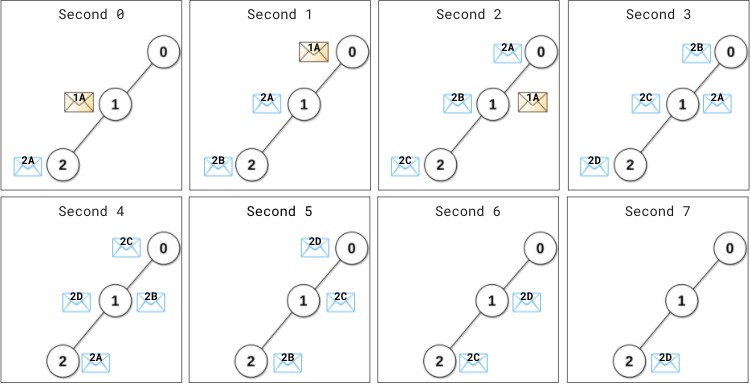
Input: edges = [[0,1],[1,2]], patience = [0,2,1]
Output: 8
Explanation:
At (the beginning of) second 0,
- Data server 1 sends its message (denoted 1A) to the master server.
- Data server 2 sends its message (denoted 2A) to the master server.

At second 1,
- Message 1A arrives at the master server. Master server processes message 1A instantly and sends a reply 1A back.
- Server 1 has not received any reply. 1 second (1 < patience[1] = 2) elapsed since this server has sent the message, therefore it does not resend the message.
- Server 2 has not received any reply. 1 second (1 == patience[2] = 1) elapsed since this server has sent the message, therefore it resends the message (denoted 2B).

At second 2,
- The reply 1A arrives at server 1. No more resending will occur from server 1.
- Message 2A arrives at the master server. Master server processes message 2A instantly and sends a reply 2A back.
- Server 2 resends the message (denoted 2C).
...
At second 4,
- The reply 2A arrives at server 2. No more resending will occur from server 2.
...
At second 7, reply 2D arrives at server 2.

Starting from the beginning of the second 8, there are no messages passing between servers or arriving at servers.
This is the time when the network becomes idle.
Example 2:

Input: edges = [[0,1],[0,2],[1,2]], patience = [0,10,10]
Output: 3
Explanation: Data servers 1 and 2 receive a reply back at the beginning of second 2.
From the beginning of the second 3, the network becomes idle.
Constraints:
n == patience.length2 <= n <= 105patience[0] == 01 <= patience[i] <= 105for1 <= i < n1 <= edges.length <= min(105, n * (n - 1) / 2)edges[i].length == 20 <= ui, vi < nui != vi- There are no duplicate edges.
- Each server can directly or indirectly reach another server.

Solution
Clarifying Questions
When you get asked this question in a real-life environment, it will often be ambiguous (especially at FAANG). Make sure to ask these questions in that case:
- What are the constraints on the size of the `edges` and `patience` arrays? What is the maximum value of `n`?
- Can we assume that the graph represented by `edges` is always connected? What should I return if the graph is not connected?
- What are the possible values for the elements in the `patience` array? Can they be zero?
- Could you clarify the structure of the `edges` array? Is it a list of tuples representing (server1, server2) connections, and is the graph undirected?
- Is there a maximum number of edges connected to a single server? This will affect the time to respond from a server and thus the overall idle time.
Brute Force Solution
Approach
We need to figure out when the whole network becomes quiet after sending messages. The brute force method involves simulating the entire messaging process step by step, tracking when each node finishes its activities and when the network reaches a state of complete inactivity.
Here's how the algorithm would work step-by-step:
- Start by sending the initial message from the central server to each of the other computers.
- For each computer that receives a message, calculate how long it takes for that computer to process the message and then send a response back to the central server.
- Keep track of when each response arrives at the central server.
- For each computer, figure out the next time it will need to send another message. This depends on the initial message delay and how often the computer gets pinged.
- Continue simulating the messaging process over time, noting when each computer is sending or receiving messages and when it's idle.
- Keep going until all the computers have sent their final messages and have received all the responses, with no more messages in transit.
- The time when the last activity happens is the time when the entire network becomes idle.
Code Implementation
def network_idle_time_brute_force(edges, patience):
    number_of_servers = len(patience)
    time_of_last_activity = [0] * number_of_servers
    time = 0
    messages_to_process = []

    # Initially, all servers send a message to server 0 at time 0
    for server_index in range(1, number_of_servers):
        messages_to_process.append((0, server_index, 0))

    while messages_to_process:
        time, sending_server, receiving_server = messages_to_process.pop(0)

        travel_time = 0
        for start, end, time_taken in edges:
            if (start == sending_server and end == receiving_server) or \
               (start == receiving_server and end == sending_server):
                travel_time = time_taken
                break

        arrival_time = time + travel_time

        # Update the last activity time for the receiving server
        time_of_last_activity[receiving_server] = max(
            time_of_last_activity[receiving_server], arrival_time
        )

        if receiving_server != 0:
            continue

        # Central server sends a reply
        reply_arrival_time = arrival_time + travel_time
        time_of_last_activity[sending_server] = max(
            time_of_last_activity[sending_server], reply_arrival_time
        )

        # Server sends another message after waiting
        next_message_time = reply_arrival_time + patience[sending_server]

        # Only server at index 0 receives/sends the replies
        messages_to_process.append((next_message_time, sending_server, 0))

return max(time_of_last_activity) + 0Big(O) Analysis
Optimal Solution
Approach
The key to solving this problem efficiently is to figure out when each server is ready to receive a new message. Instead of simulating the entire process, we use the network delay to calculate the earliest possible time each server will be idle.
Here's how the algorithm would work step-by-step:
- First, figure out how long it takes to send a message to each server. Since the connections form a network, you'll need to find the shortest path to each server from the main server.
- Next, determine the last time a message was sent to each server. Each server has a specific 'transmission delay' value. The last message time is based on how long it takes to reach the server, multiplied by twice its transmission delay.
- Finally, find the latest of all these 'last message' times. That's the time when the entire network becomes idle, because all servers have finished processing their last messages.
Code Implementation
def get_idle_time(server_travel_times, patience_time):
    number_of_servers = len(server_travel_times)
    last_receive_times = []

    for i in range(number_of_servers):
        round_trip_time = 2 * server_travel_times[i]

        # Find the last time the server sends a message
        last_send_time = (round_trip_time // patience_time) * patience_time

        # Calculate when the main server receives the last echo
        last_receive_time = last_send_time + round_trip_time
        last_receive_times.append(last_receive_time)

    # Find the maximum receive time, which is when the network is idle
    network_idle_time = max(last_receive_times) + 1

return network_idle_timeBig(O) Analysis
Edge Cases
| Case | How to Handle |
|---|---|
| Null or empty edges array | Return 0 as the network is immediately idle with no connections. |
| Null or empty patience array | Return 0 if the patience array is null or empty, indicating no servers to wait for. |
| Single server (n=1) | Return 0, as server 0 is the only server and doesn't need to wait for responses. |
| Edges form a disconnected graph | The algorithm should still correctly compute the idle time for reachable servers, treating unreachable servers as if they never responded. |
| Edges contain a cycle | The BFS algorithm should handle cycles correctly by using a visited set to avoid infinite loops. |
| Large number of servers (n is large) | Ensure the BFS and any auxiliary data structures (like adjacency lists) scale well to prevent memory issues or excessive runtime. |
| Patience values are very large leading to integer overflow in calculations | Use long data type for calculations to avoid potential integer overflow issues when calculating the final idle time. |
| All patience values are 0 | The idle time calculation must correctly handle zero patience, which means the server responds immediately after receiving the message. |






