

Tree of Coprimes
Hard

There is a tree (i.e., a connected, undirected graph that has no cycles) consisting of n nodes numbered from 0 to n - 1 and exactly n - 1 edges. Each node has a value associated with it, and the root of the tree is node 0.
To represent this tree, you are given an integer array nums and a 2D array edges. Each nums[i] represents the ith node's value, and each edges[j] = [uj, vj] represents an edge between nodes uj and vj in the tree.
Two values x and y are coprime if gcd(x, y) == 1 where gcd(x, y) is the greatest common divisor of x and y.
An ancestor of a node i is any other node on the shortest path from node i to the root. A node is not considered an ancestor of itself.
Return an array ans of size n, where ans[i] is the closest ancestor to node i such that nums[i] and nums[ans[i]] are coprime, or -1 if there is no such ancestor.
Example 1:
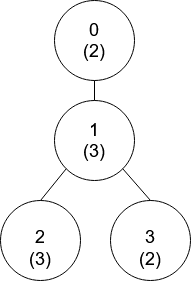
Input: nums = [2,3,3,2], edges = [[0,1],[1,2],[1,3]]
Output: [-1,0,0,1]
Explanation: In the above figure, each node's value is in parentheses.
- Node 0 has no coprime ancestors.
- Node 1 has only one ancestor, node 0. Their values are coprime (gcd(2,3) == 1).
- Node 2 has two ancestors, nodes 1 and 0. Node 1's value is not coprime (gcd(3,3) == 3), but node 0's
  value is (gcd(2,3) == 1), so node 0 is the closest valid ancestor.
- Node 3 has two ancestors, nodes 1 and 0. It is coprime with node 1 (gcd(3,2) == 1), so node 1 is its
  closest valid ancestor.
Example 2:

Input: nums = [5,6,10,2,3,6,15], edges = [[0,1],[0,2],[1,3],[1,4],[2,5],[2,6]]
Output: [-1,0,-1,0,0,0,-1]
Constraints:
nums.length == n1 <= nums[i] <= 501 <= n <= 105edges.length == n - 1edges[j].length == 20 <= uj, vj < nuj != vj

Solution
Clarifying Questions
When you get asked this question in a real-life environment, it will often be ambiguous (especially at FAANG). Make sure to ask these questions in that case:
- What are the constraints on the values within the tree nodes? Can they be zero or negative?
- How is the tree represented? Is it a list of edges or an adjacency list, and how are the nodes indexed?
- If there are multiple nodes with a coprime value on the path to the root, which one should I return?
- What should be returned if no coprime ancestor exists for a node?
- What is the maximum possible depth of the tree?
Brute Force Solution
Approach
The brute force approach to this problem means checking every possible path in the tree to find the 'closest' node with a 'coprime' value. We will visit each node in the tree, comparing its value to every value of its ancestors to find the closest coprime one.
Here's how the algorithm would work step-by-step:
- Start at the very first node, the root of the tree.
- Look at all the nodes above it, going straight up to its parent, grandparent, and so on, all the way back to the root.
- For each of those ancestor nodes, check if the current node's value and the ancestor node's value are 'coprime' which means they share no common divisors other than one.
- If you find an ancestor node that is coprime, remember it as the 'closest coprime ancestor'.
- Move to the next node in the tree and repeat the process: check all the nodes directly above it to find the closest coprime ancestor.
- Keep doing this for every single node in the tree.
- If no coprime ancestor is found for a node, mark it with a special value (like -1).
- After checking every node, you will have a list that tells you, for each node, which ancestor is its closest coprime ancestor.
Code Implementation
def tree_of_coprimes_brute_force(numbers, edges):

    graph = [[] for _ in range(len(numbers))]
    for edge_start, edge_end in edges:
        graph[edge_start].append(edge_end)
        graph[edge_end].append(edge_start)

    result = [-1] * len(numbers)

    def gcd(first_number, second_number):
        while(second_number):
            first_number, second_number = second_number, first_number % second_number
        return first_number

    def depth_first_search(node, parent, ancestors):
        closest_coprime_ancestor = -1
        min_depth = float('inf')

        # Check for coprime ancestor to current node
        for depth, ancestor_value in reversed(ancestors):
            if gcd(numbers[node], ancestor_value) == 1:
                closest_coprime_ancestor = depth
                break

        if closest_coprime_ancestor != -1:
            result[node] = closest_coprime_ancestor

        new_ancestors = ancestors + [(node, numbers[node])]

        # Traverse the tree to find all nodes
        for neighbor in graph[node]:
            if neighbor != parent:
                depth_first_search(neighbor, node, new_ancestors)

    # Initialize DFS from the root
    depth_first_search(0, -1, [])

return resultBig(O) Analysis
Optimal Solution
Approach
This problem involves a family tree where each person has a value, and we want to find the closest ancestor with a value that shares no common factors with theirs. We use a technique that combines walking up the tree with pre-calculated relationships to avoid unnecessary checks.
Here's how the algorithm would work step-by-step:
- Calculate the greatest common divisor between each person's value and the values of all their relatives.
- As we move through the tree, keep track of all ancestors along the way, associating their values with their position in the family tree.
- For each person, check their ancestors in reverse order of closeness to find the first one whose value shares no common factors with theirs.
- If we can't find such an ancestor, mark this person's answer as -1.
- Store the results so that each person knows which ancestor meets the condition.
- Report the stored results.
Code Implementation
import math

def tree_of_coprimes(numbers, edges):
    number_of_nodes = len(numbers)
    adjacency_list = [[] for _ in range(number_of_nodes)]

    for edge_start, edge_end in edges:
        adjacency_list[edge_start].append(edge_end)
        adjacency_list[edge_end].append(edge_start)

    results = [-1] * number_of_nodes

    def gcd(first_number, second_number):
        while(second_number):
            first_number, second_number = second_number, first_number % second_number
        return first_number

    def depth_first_search(node_index, parent_node, ancestor_list):
        # Check ancestors for a coprime value.
        for ancestor_index in range(len(ancestor_list) - 1, -1, -1):
            if gcd(numbers[node_index], numbers[ancestor_list[ancestor_index][0]]) == 1:
                results[node_index] = ancestor_list[ancestor_index][0]
                break

        # Traverse through all neighbors.
        for neighbor_node in adjacency_list[node_index]:
            if neighbor_node != parent_node:
                # Add the current node to the ancestor list for the child.
                new_ancestor_list = ancestor_list + [(node_index, numbers[node_index])]
                depth_first_search(neighbor_node, node_index, new_ancestor_list)

    # Initiate DFS from the root (node 0) with an empty ancestor list.
    depth_first_search(0, -1, [])

return resultsBig(O) Analysis
Edge Cases
| Case | How to Handle |
|---|---|
| Null or empty input array for the tree node values. | Return an empty result array or handle it as an invalid input, preventing null pointer exceptions. |
| The 'edges' input is null or empty, implying a single-node tree. | Initialize the result array with -1 for the single node since no parent exists. |
| Input edges contain cycles, forming a graph instead of a tree. | Detect cycles during graph construction and either throw an error or handle the cyclic components as independent trees. |
| A node has no coprime ancestor. | The result for that node should be -1 as specified in the problem description. |
| Large tree depth that might cause stack overflow in recursive solutions. | Convert the recursive solution to an iterative one using a stack to avoid stack overflow errors. |
| Integer overflow when calculating GCD for very large numbers. | Use appropriate data types (e.g., long) or bitwise GCD algorithms to prevent overflow. |
| All node values are the same, such as 1, which means every node is coprime to every other. | The nearest ancestor is the parent, so the answer becomes the parent in this case. |
| The input tree is skewed, such as a linked list represented as a tree. | The algorithm should still perform correctly but may have a higher time complexity depending on the implementation. |






