

Water Bottles
Easy




There are numBottles water bottles that are initially full of water. You can exchange numExchange empty water bottles from the market with one full water bottle.
The operation of drinking a full water bottle turns it into an empty bottle.
Given the two integers numBottles and numExchange, return the maximum number of water bottles you can drink.
Example 1:

Input: numBottles = 9, numExchange = 3
Output: 13
Explanation: You can exchange 3 empty bottles to get 1 full water bottle.
Number of water bottles you can drink: 9 + 3 + 1 = 13.
Example 2:
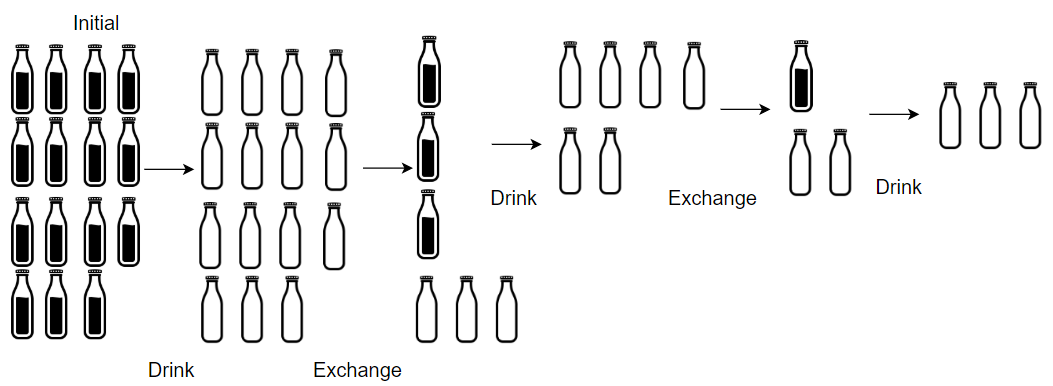
Input: numBottles = 15, numExchange = 4
Output: 19
Explanation: You can exchange 4 empty bottles to get 1 full water bottle.
Number of water bottles you can drink: 15 + 3 + 1 = 19.
Constraints:
1 <= numBottles <= 1002 <= numExchange <= 100

Solution
Clarifying Questions
When you get asked this question in a real-life environment, it will often be ambiguous (especially at FAANG). Make sure to ask these questions in that case:
- Can `numBottles` or `numExchange` be zero or negative? What are the maximum possible values for these inputs?
- If I can't exchange any more bottles (e.g., I have fewer than `numExchange` empty bottles), do I stop drinking?
- What should I return if `numExchange` is greater than `numBottles`? Is that considered a valid input?
- Are both `numBottles` and `numExchange` integers?
- Should I account for the case where `numExchange` is equal to 1? How should that be handled?
Brute Force Solution
Approach
The problem asks how many total bottles you can drink given an initial number of bottles and an exchange rate. The brute force method simulates the entire process, step by step, until you can't exchange any more bottles.
Here's how the algorithm would work step-by-step:
- Start with the initial number of full bottles you have.
- Drink all of them, adding that number to the total bottles drunk.
- Now, count how many empty bottles you have.
- Exchange as many empty bottles as possible for new full bottles, based on the exchange rate.
- Add the number of newly exchanged full bottles to the total bottles drunk.
- Update the number of empty bottles by subtracting the number you exchanged and adding the number you just drank.
- Repeat steps 4-6 until you don't have enough empty bottles to exchange for a full one.
Code Implementation
def total_water_bottles(initial_bottles, exchange_rate):
    total_drunk_bottles = 0
    empty_bottles = 0
    full_bottles = initial_bottles

    # Start with the initial number of full bottles.
    total_drunk_bottles += full_bottles
    empty_bottles += full_bottles

    while empty_bottles >= exchange_rate:
        # Exchange empty bottles for new full bottles.
        new_full_bottles = empty_bottles // exchange_rate
        total_drunk_bottles += new_full_bottles

        # Update the number of empty bottles after the exchange
        empty_bottles = empty_bottles % exchange_rate + new_full_bottles

return total_drunk_bottlesBig(O) Analysis
Optimal Solution
Approach
The problem involves figuring out how many total water bottles you can drink, considering you can exchange empty bottles for more water. The core idea is to keep track of how many full bottles you have and how many empties you accumulate as you drink.
Here's how the algorithm would work step-by-step:
- Start with the initial number of full water bottles you can drink.
- After drinking those, you'll have a certain number of empty bottles.
- Figure out how many additional full bottles you can get by exchanging those empties.
- Drink those new bottles, which then creates more empty bottles.
- Repeat the exchanging and drinking process until you no longer have enough empty bottles to exchange for a full one.
- Add up all the full bottles you drank in each step to get the total.
Code Implementation
def numWaterBottles(initial_bottles, num_exchange):
    total_drunk_bottles = initial_bottles
    empty_bottles = initial_bottles

    while empty_bottles >= num_exchange:
        # Calculate how many new bottles we can get.
        new_bottles = empty_bottles // num_exchange

        # Add the new bottles to the total.
        total_drunk_bottles += new_bottles

        # Update the number of empty bottles after the exchange.
        empty_bottles %= num_exchange
        empty_bottles += new_bottles

return total_drunk_bottlesBig(O) Analysis
Edge Cases
| Case | How to Handle |
|---|---|
| bottles is zero | Return 0 immediately as no drinks are possible. |
| bottles is negative | Return 0, as negative bottles are nonsensical in the given context. |
| bottles is a very large number, numExchange is small | Potential for integer overflow if not careful with multiplication/addition; use appropriate data types or modular arithmetic if required by constraints. |
| numExchange is zero or negative | If numExchange is zero, return bottles as no exchange can occur; if negative return 0 as it's nonsensical. |
| numExchange is one | The loop might never terminate if not handled carefully since any number of empty bottles can be exchanged. |
| bottles is less than numExchange | The drinking stops after initial bottles as no exchange possible. |
| bottles equals numExchange | Only one additional bottle is consumed after the initial bottles |
| Integer overflow during calculations | Utilize larger integer types (long) or consider if modular arithmetic is needed depending on the problem constraints to avoid potential overflow. |






