

Widest Vertical Area Between Two Points Containing No Points
Easy





Given n points on a 2D plane where points[i] = [xi, yi], Return the widest vertical area between two points such that no points are inside the area.
A vertical area is an area of fixed-width extending infinitely along the y-axis (i.e., infinite height). The widest vertical area is the one with the maximum width.
Note that points on the edge of a vertical area are not considered included in the area.
Example 1:
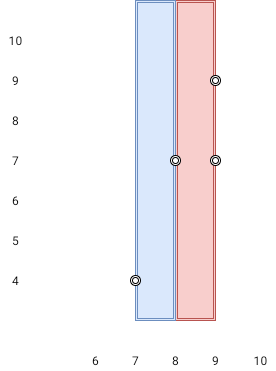
Input: points = [[8,7],[9,9],[7,4],[9,7]]
Output: 1
Explanation: Both the red and the blue area are optimal.
Example 2:
Input: points = [[3,1],[9,0],[1,0],[1,4],[5,3],[8,8]]
Output: 3
Constraints:
n == points.length2 <= n <= 105points[i].length == 20 <= xi, yi <= 109

Solution
Clarifying Questions
When you get asked this question in a real-life environment, it will often be ambiguous (especially at FAANG). Make sure to ask these questions in that case:
- What is the expected data type for the coordinates? Are they integers or floating-point numbers?
- What are the constraints on the coordinate values? Can they be negative, zero, or extremely large?
- If all points have the same x-coordinate, or there are fewer than two points, what should the function return?
- Are there any duplicate points in the input? If so, how should they be handled?
- Should the vertical area be considered 'containing no points' if a point lies exactly on the left or right edge of that area?
Brute Force Solution
Approach
We want to find the biggest horizontal gap between two points, where there are no other points in between. The brute force method involves checking every possible pair of points to see if they create the widest empty vertical area.
Here's how the algorithm would work step-by-step:
- Take the first point and compare its horizontal position to the horizontal position of every other point.
- For each comparison, calculate the horizontal distance between those two points.
- Check if there are any other points that lie horizontally between these two points. If there are, this interval is not valid.
- If no points lie between them, save this horizontal distance as a possible widest area.
- Repeat this process, starting with the second point, then the third, and so on, until you've considered every possible pair of points.
- Finally, compare all the saved distances, and choose the largest one. This largest distance is the widest empty vertical area.
Code Implementation
def widest_vertical_area_brute_force(points):
    max_width = 0

    # Iterate through each point to find the max width possible
    for first_point_index in range(len(points)):
        for second_point_index in range(first_point_index + 1, len(points)):
            first_point_x = points[first_point_index][0]
            second_point_x = points[second_point_index][0]
            width = abs(first_point_x - second_point_x)

            # Check if any points exist between the current two points
            is_valid = True

            min_x = min(first_point_x, second_point_x)
            max_x = max(first_point_x, second_point_x)

            for other_point_index in range(len(points)):
                if other_point_index == first_point_index or other_point_index == second_point_index:
                    continue

                other_point_x = points[other_point_index][0]

                # Check if other_point_x lies strictly between min_x and max_x
                if min_x < other_point_x < max_x:
                    is_valid = False

                    break

            # Update the max_width if the current width is valid and larger
            if is_valid:

                max_width = max(max_width, width)

return max_widthBig(O) Analysis
Optimal Solution
Approach
The goal is to find the biggest gap between the horizontal positions of the points. We only care about the horizontal distance, so an effective approach involves focusing only on the horizontal positions and then finding the largest difference between adjacent horizontal positions after sorting.
Here's how the algorithm would work step-by-step:
- First, focus on only the horizontal position of each point. Disregard the vertical positions.
- Next, sort the horizontal positions from smallest to largest.
- Then, go through the sorted horizontal positions, comparing each one to the one before it to find the difference. Keep track of the largest difference you've seen so far.
- Finally, the largest difference you tracked is the widest vertical area with no points in between.
Code Implementation
def find_max_width(points):
    horizontal_positions = []
    for point in points:
        horizontal_positions.append(point[0])

    # Sorting allows for easy comparison of adjacent positions.
    horizontal_positions.sort()

    max_width = 0
    # Find the largest difference between adjacent points
    for i in range(1, len(horizontal_positions)):
        width = horizontal_positions[i] - horizontal_positions[i-1]
        if width > max_width:
            max_width = width

    # Return the max width
return max_widthBig(O) Analysis
Edge Cases
| Case | How to Handle |
|---|---|
| Empty input array of points | Return 0 immediately since there are no points to form an area. |
| Input array with only one point | Return 0 immediately as two points are required to calculate an area. |
| All points have the same x-coordinate | The widest area will be 0, so the solution should return 0. |
| Points are already sorted by x-coordinate | The sorting step should still execute correctly and not introduce errors or inefficiencies. |
| Large number of points to ensure efficient sorting | Use an efficient sorting algorithm like merge sort or quicksort to maintain O(n log n) time complexity. |
| Points with very large or very small x-coordinates (potential overflow) | Use appropriate data types (e.g., long) to prevent integer overflow when calculating the difference between x-coordinates. |
| Duplicate points in the input array | Duplicate points won't affect the correctness of the solution since we're only concerned with the widest area. |
| Input array contains unsorted points with very close x coordinates | Sorting will resolve the proximity and the loop comparing adjacent points will correctly identify the smallest distance. |






